A COUNTERFEIT STORY

arc1

The former Conoco station between Arcadia and Luther, Oklahoma.

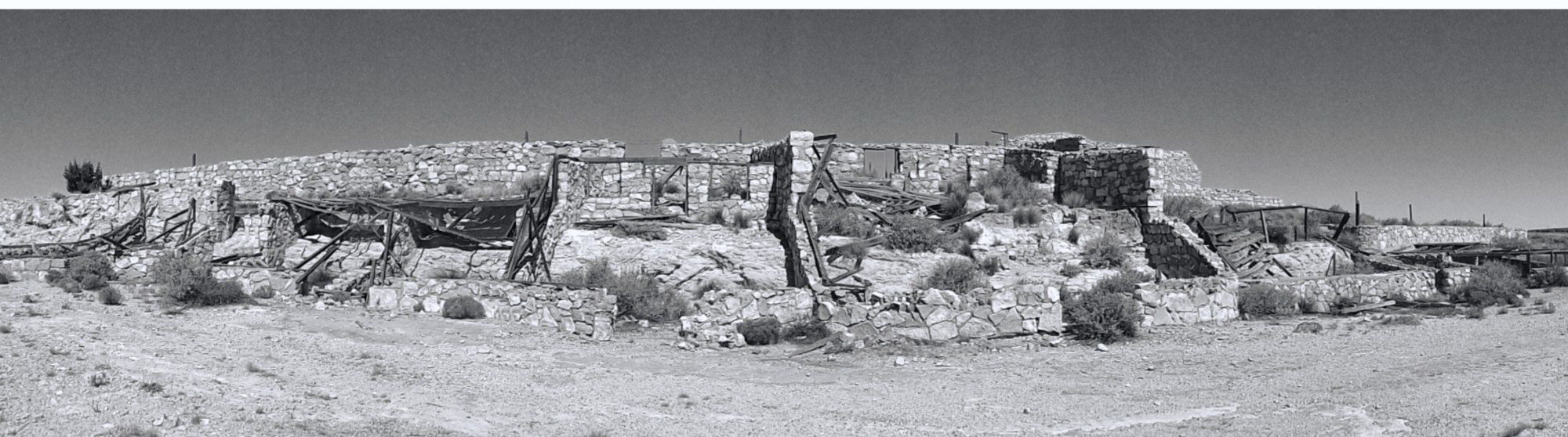
Just between Arcadia and Luther, Oklahoma, on Route 66, is a small stone ruin on the side of the road. There’s a homemade sign which says ‘HISTORICAL BUILDING “RT 66”’ but no further explanation.

arc2

The front of the Conoco station where the pumps would have once stood.

This was once a Conoco gas station, one of the earliest in this part of the country, and one of the few of which anything remains. Despite its age – it was probably built around the early 1920s and certainly pre-dates Route 66 – there would be little to mark it from any other stone ruin were it not for the fact this little place has a story. But is it story or myth?

This place doesn’t even appear to have had a name – I’ve seen it referred to as the Old Rock station, but that might simply be a handy description rather than an actual title. However, as it stands on the edge of land belonging to the Rock of Ages Farm, it seems as useful a shorthand as any. The gas station had two fuel pumps, one for regular gas and one for ethyl, as well as dispensing drums for oil and kerosene. The latter was necessary because electricity was a long way from making it out to this remote spot and most homes and buildings used kerosene lamps. So far it was no different from the dozens of little gas stations that sprang up to service the growing wave of motorists.

arc5

The fireplace at the rear of the store which would have been the only source of heat.

But, so the story will have it, despite bearing the Conoco name, the place fell upon hard times, and sometime in the 1930s, a passing salesman offered to sell the owners printing plates for making counterfeit $10 bills. It was, apparently, too good an opportunity to miss. A small room was built on the back of the already tiny building, the entrance to this hideaway through a rear window which was kept boarded up. The bills were printed one side at a time but clearly they weren’t quite the key to fortune the station’s owners had hoped; when one of them was arrested while trying to pass one of the phony bills, the police searched the fuel station and found the printing plates. The gas station closed and never re-opened.

It’s a great story. The trouble is there is no evidence that it ever happened.

Back in the 1930s, the newspaper was king and Oklahoma possessed several lively papers that covered every scrap of news available. Yet there is no mention of any counterfeiting ring at the Old Rock or, for that matter, anyone from Luther being arrested for just about anything. Counterfeiting was a popular crime during the 1930s and the newspapers of the time covered many such police investigations and trials in huge detail, but not one mentioned anywhere or anything that could be conceivably linked to the Conoco station.

arc 6

Lyle Dean Melton (left) and Red Abbott. Probably not hardened counterfeiters…

There is no trace of the hidden room at the ruin or even any indication of how it might have been constructed, while the only known photograph of the operating gas station is not only clearly marked ‘1940’ – after the supposedly crime and closure – it also names the two men in the photo as ‘Red Abbott’ and ‘Lyle Melton’ and it’s a reasonable supposition that they either owned or worked there. Red Abbott seems lost to time, but Lyle, 29 years old when the photograph was taken, was from a large family which had settled in Luther. There’s no evidence that he was ever in trouble (least of all for counterfeiting) and, although he and his wife Mary later moved away, they are both buried in Luther Cemetery, along with his parents and four of his ten siblings. None of the family were born in the little town; they were from Christian, Missouri, but clearly they were sufficiently attached to Luther to make it their place of eternal rest, which might not necessarily have been the case if one member of the family had been a notorious local criminal.

arc3

The window in the rear wall was, apparently, the entrance to the hidden room where $10 bills were printed.

It’s not the only dubious but unsubstantiated claim to criminal fame given to Luther. Several notable books on Route 66 state that it was near the gas station that, a few days after Christmas 1950, serial killer Billy Cook abducted and killed the Mosser family from Illinois. However, the unfortunate Mossers didn’t get as far as Luther; when they stopped for a hitchhiker it was between Claremore and Tulsa, some way further east. But sometimes the story is just better than the truth…

THE TRADING ATKINSONS OF ROUTE 66

IMG_1850

THE REMAINS OF THE RATTLE SNAKE TRADING POST, BLUEWATER, NM, 2015

In a time when almost every town along Route 66 had a trading post, one small place spawned two families who would not only establish networks of stores but who would, in the 21st century, still be in business.

In the 1940s, Bluewater in New Mexico was home to trading posts owned by Claude Bowlin, the man behind what would become Bowlin’s Travel Centers of which there are 10 across New Mexico and Arizona, but also to the Atkinson family. The Atkinsons were from Texas and during the Great Depression, Leroy Atkinson, the oldest brother of three, headed to New Mexico with his wife and just $18 dollars in his pocket. Leroy was a high school football star when he met Wilmerine Bollin and they had been married in 1935; he was 19 and his wife 17. Leroy found work at the Three Hogans Trading Post in west of Lupton and was later joined by his two young brothers, Herman and Jake.

boxcanyon

LEROY ATKINSON’S BOX CANYON TRADING POST WHICH WAS DEMOLISHED IN A REALIGNMENT OF ROUTE 66 IN 1953

In 1943, Leroy started the Box Canyon Trading Post on the Arizona/New Mexico state line on land leased from Harry Miller, the man who had developed Two Guns. (This was shortly after Miller had been being tried for murder – but that’s another story). The Box Canyon Trading Post prospered; it had a gas station, auto court, store and café. Oh, and live buffalo. However the growth in traffic that ensured its short-term success was also its downfall. The increasing traffic on Route 66 resulted in the road being realigned and running straight through the trading post. In 1953 the Box Canyon Trading Post was demolished and Leroy and Wilmerine moved to Albuquerque.

NM083150

JAKE ATKINSON’S RATTLE SNAKE TRADING POST, BLUEWATER, NM, IN ITS PRIME

In the meantime, the other two brothers had also moved into the retail trade. In 1945, middle brother Jake and his wife Maxine bought the Brock Trading Post from Victor Holmes after briefly running the Stateline Trading Post a mile west of Leroy’s emporium. In order to attract passing trade, they tied burros to the gas pumps, staged cockfights and, most spectacularly, renamed it the Rattlesnake Trading Post. It did indeed have rattlesnakes as well as a café and a night club. Billboards along the highway also advertised that you could see the skeleton of a 48-foot long prehistoric reptile. Anyone who looked closely at that marvel might have wondered why it was made out of a cow skull, cow vertebrae and a good quantity of plaster.

JAKE ATKINSON'S RATTLE SNAKE TRADING POST AT BLUEWATER, NEW MEXICO. C.1952

In 1951, Jake and Maxine sold the trading post to her sister and brother-in-law who kept the name, if not the reptile gardens. But it had clearly given Herman, the youngest brother, an idea. Arriving home from the services, he decided to start his own reptile-inspired ranch. On 1st May 1946, 26-year-old Herman and his 24-year-old wife, Phyllis, opened the Lost Canyon Trading Post a mile and a half east of Grants near what is now Airport Road. To attract trade, they bought two baby boa constrictors which they advertised as the ‘Den of Death’. When the pair of snakes brought in more customers than the souvenirs, he decided to build a large reptile house and charge admission. By the early 1950s, Atkinson’s Cobra Gardens had around 300-400 snakes, including rattlesnakes, anacondas, pythons and cobras. It was the collection of cobras in the USA and attracted thousands of visitors from both home and abroad.

cobragardens

HERMAN ATKINSON’S COBRA GARDENS NEAR GRANTS. c 1952

However the heyday of the Cobra Gardens lasted less than ten years. Although it made Herman a very successful man, he sold the trading post in 1953, quietly selling his collection of snakes through the classified ads of Billboard in an ad that began GOING OUT OF BUSINESS. He listed a ’13 foot, heavy’ African python for $300, down to ‘assorted small rattlesnakes, $1’ from his home at 51 East Congress Street in Tucson.

herman1

HERMAN ATKINSON, THE COBRA KING. 1953

Herman had seen which way the wind was blowing. The area was moving towards mining and not tourism and there was talk that an interstate highway was planned that would bypass Route 66. He sold the Cobra Gardens and it became the somewhat less threatening Cactus Garden Trading Post. Herman and Phyllis moved to Scottsdale, Arizona, where he established Atkinson’s Trading Post, which he ran until his death in 2009 at the age of 89. His wife, Phyllis, passed away three years later but their daughter Marilyn continues to operate the store. After he sold the Cobra Gardens, Herman never had anything else to do with reptiles.

Leroy opened the Indian Village company in Tucson with Jake, with Jake eventually taking it over. The company is still in the Atkinson family, now run by Jake’s son, John. Jake and Leroy both passed away in the late 1980s and little remains of the Atkinsons’ early roots. The Box Canyon Trading Post disappeared underneath Route 66; the Cobra Gardens was demolished in 2011 and the only building that remains is Jake’s store in Bluewater. Look closely and you can see, across the front of a crumbling building, faded paint that reads RATTLESNAKES. Listen hard and you might just hear on the wind the excited chatter of travellers, pulling off 66 to stroke a burro and see a real live rattlesnake…

THE 11TH STREET BRIDGE

Tulsa old and new - looking from the 11th Street Bridge to the city centre

Tulsa old and new: looking from the middle of the 11th Street Bridge towards the city centre

While I may be never quite lost, sometimes I find myself in places where I possibly shouldn’t be. But rarely in plain sight in the middle of a city.

Tulsa, Oklahoma, was built on oil, but it was also the hometown of Cyrus Avery, ‘the Father of Route 66’, and he would probably never have been welcomed home again if he hadn’t ensured that new highway ran through Tulsa. However, there are a couple of equally likely and valid reasons; Tulsa had a bridge.

NE towards 11th St Bridge in 1917, shortly after it opened

The bridge in 1917, shortly after opening

Moreover, it was the first purpose-built automobile bridge to span the 1450 miles of the Arkansas River which runs through the city. Built in 1916, it was something of a wonder for the flatlands. One of the longest concrete structures in the Midwest, it was also the first major multi-span (eighteen of them) concrete bridge in Oklahoma. By providing an easy crossing of the Arkansas, it allowed the oil industry in Tulsa to flourish.

And the second reason? Remember that Cyrus Avery came from Tulsa; serving as Oklahoma County Commissioner from 1913 to 1916, he was involved with the construction of the bridge and it must have had a place in his heart. Even today, it’s still a structure of which to be proud.

It was built by the Missouri Valley Bridge and Iron Company for $180,000, and, at 1470 feet long and 34 feet wide, supported a railroad track in the middle and a single lane of vehicular traffic either side, flanked by pavements. In 1934, it was widened to 52 feet and 8 inches and could accommodate four lanes of traffic. Careful traffic, that is. 52 feet is not all that wide…

There was a gate open. Honest

There was a gate open – honest!

And, for the next 63 years, the 11th Street Bridge served Tulsa well, bringing prosperity into the city, and allowing travellers to make their way across Oklahoma to the promised lands via Route 66. But it started to show its age. Lanes were closed, load limits implemented and then, in 1975, the City had to pay compensation to a woman who fell through a hole in one of the walkways. It was only $1100, but it was a wake-up call that the bridge was in trouble. A new crossing was commissioned and, in 1980, the 11th Street Bridge was closed to traffic. There was talk of tearing it down, but, luckily, the money to demolish it never seemed to quite transpire.


Even the weeds have to fend for themselves

Too dangerous for city employees to step onto the bridge to spray them, the weeds are taking over

In 2004, the bridge was renamed the Cyrus Avery Route 66 Memorial Bridge, but a new fancy name didn’t make it any more structurally sound. Then, in 2008, it was closed to even pedestrians, a plan to make it safe enough to reopen to walking traffic having been costed at $15 million. Rather than spend that sort of money, the city gave the bridge a bit of a spruce up and then gated it off. This was after surveyors decided that the bridge was too unsafe to even walk on. I suspect they probably don’t even want you to look at it that hard. The blacktop on the bridge is actually just a waterproof coating and the bridge is too weak to hold up another layer of asphalt. The city sprays the weeds occasionally, but even that is considered risky.

The 'Cyrus Avery Memorial Bridge' from the Cyrus Avery Memorial Plaza. Those Tulsans are proud of their native son.

Looking down the Cyrus Avery Memorial Bridge from the Cyrus Avery Centennial Plaza. Tulsa is proud of its native son

Now, I have to say I didn’t know all this when I found myself at the 11th Street Bridge one grey October morning. I don’t know why a side gate was open, but even if I had realised that there was a distinct possibility a hole might open up underneath me and plunge me into the muddy waters of the Arkansas River, then I would probably still have walked its length. Only afterwards did I realise how lucky I was to have had that chance.

THE MAN WHO WROTE ROUTE 66

150076645.EoicnvWE.AGuideBookToHighway66

There is one man – other than, of course, Cyrus Avery – to whom Route 66 aficionados owe a debt of gratitude. Yet most people know very little about Jack DeVere Rittenhouse, other than the fact that he wrote one of the seminal works on the Mother Road.

In 1946, Rittenhouse published A Guide Book to Highway 66, not only the first book on Route 66, then only two decades old, but the first to chronicle any major highway in the USA. When that book was reprinted in 1988, Rittenhouse wrote the foreword, which is how we know that he undertook the trip in a 1939 American Bantam. For the time, it was tiny – even to modern eyes it looks like the sort of car Noddy or Minnie Mouse might have driven and, in fact, a 1938 American Bantam was the inspiration for Donald Duck’s car. Rittenhouse doesn’t even tell us which model he drove, although it seems likely, as he refers to the lack of trunk, that it was a four-seater Model 60.

Jack Rittenhouse was born in Kalamazoo, Michigan, in 1912 and developed a love of books in childhood. When he was little more than a toddler, his family moved to Arizona, although he returned east as a young man and attended Indiana State Teachers College for three years until the Depression forced him to leave and get a job. Unfortunately his first job, writing book reviews at the Fort Wayne Journal-Gazette didn’t pay, and the young Jack made a few dollars by selling his review copies to libraries. Little is known of his early personal life, although he married Beulah Rose Scherrer on 17th May 1935 in Elkhart, Indiana when she was just 19 years old. There couldn’t have been much of a honeymoon for the very next month, Rittenhouse was riding freight trains to New York City to search for work in publishing.

He was employed by Park Row Books & Magazines in lower Manhattan where he sold used books for six months. But, by 1936, he was off riding freight trains across the country. What Beulah thought of this is not on record, nor what she did while he was off seeing the country, although he was clearly home on occasion because the marriage produced a son, David Kinsey, who was born in Fort Wayne, Indiana, in May 1938.

Returning to New York City, he found work with Alfred A Knopf before moving into advertising because it paid better (he did, however, continue to write a column for the Journal-Gazette, still selling off the books when he’d finished with them). When the Second World War came, he was exempt from joining up and was instead employed writing training manuals for the US Air Force. By now, his marriage to Beulah had ended in divorce and he was living in Chicago, where he met his second wife, Charlotte Jewell High, ten years his junior. They were married in 1944 in Missouri. His job in advertising took them to Los Angeles and along the way Rittenhouse realised that, with the war over, people would want to travel for pleasure and the freedom of the highway, particularly those servicemen and women from the Mid West and the East Coast who had been stationed in California, and they would use Route 66.

So, taking to the road again, this time in his little automobile rather than hopping trains, he began on his travel guide. One presumes Charlotte was a tolerant lady. He researched, wrote, designed and self-published A Guide Book to Highway 66, even drawing the maps and little illustrations, working out mileages and documenting the gas stations, tourist cabins and motels in each place along the road. He printed 3000 copies and sold them for a dollar apiece. In the rather poignant last line of the book, Rittenhouse wrote ‘If you have any suggestions on improving this Guide Book, address them to the publisher, so they can be included in future editions.’ Poignant because there were no future editions and it’s true to say that A Guide Book to Highway 66 was not a runaway success. In fact, the ‘second edition’ wouldn’t come until 1988 and that, of course, would be an accurate facsimile of the original book rather than contain any updates.

For the next few years, Rittenhouse hopped between selling rare books and working in advertising, as well as running his own one-man publisher, the Stagecoach Press. In 1952 he began his own agency, selling it to the Marsteller Company in 1959. The following year, he devoted his time to the Stagecoach Press, producing a number of titles. The publishing house went into hibernation when, after two years at the Museum of New Mexico Press, he joined the staff of the University of New Mexico Press where he worked until he retired in 1978 and promptly started up the Stagecoach once more. However, when the guide was reprinted in 1988, it was with his old employers rather than the Stagecoach Press.

Having fallen in love with New Mexico, he and Charlotte settled in Albuquerque, while Rittenhouse took great pleasure in documenting ghost towns, Indian ruins, mining camps and anywhere that ever had a post office, and many of his photographs are in the Rittenhouse Collection at the New Mexico State University Library.

Charlotte lived to the age of 90,surviving longer than her husband and all three of their children, each of whom died relatively young. Douglas died in 2001 in Texas aged 54; Susan passed the following year at the age of 49, also in Texas, while her sister Anne was just short of 55 when she died in California, having moved there with her husband, Harry Briley, in 1976.

Jack D Rittenhouse died in 1991, having lived long enough to see his little guide become a late success among a whole new generation for whom the Mother Road means nostalgia rather than freedom. Now it’s referred to and quoted by just about anyone who ever writes a word about Route 66, as well as becoming a glovebook essential, just as he intended more than half a century ago.

jack and anne

JACK AND CHARLOTTE RITTENHOUSE WITH THEIR DAUGHTER ANNE AT HER GRADUATION

GOODBYE TO THE CLUB CAFE

12113376_961168507284317_6902935718774061004_o

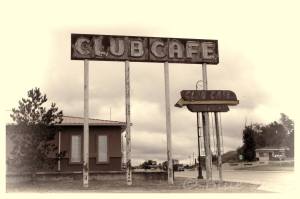
On a grey and overcast October afternoon, I stopped by at the remains of the Club Cafe in Santa Rosa, New Mexico. I didn’t take much notice of the guy with a tape measure wandering around, but I decided not to clamber through the window opening and have a last walk round the skeleton of the building. Sometimes you meet people as intrigued by a building as you and sometimes you skulk past them, eyes not meeting, knowing they don’t see what you see.

The Club Café opened in 1935, five years after the Santa Rosa stretch of Route 66 was completed; its blue-tiled frontage and smiling ‘Fat Man’ logo, a happy gent wearing a polka dot tie and looking delighted after, presumably, dining on the Club Café’s home cooking, became well-known to thousands of travellers on Route 66.

12141104_961168513950983_1831697896696195064_o

But, by the time I-40 bypassed the New Mexico town, people didn’t want home cooking. They wanted a quick stop at one of the generic fast food places just off the interstate. The Fat Man looked dated in the face of the ubiquitous clown and southern gentleman. In 1992, the Club Café closed its doors forever. It was bought by Joseph and Christiana Campos who planned to reopen it, but the building had suffered too much

11722555_961168523950982_5862782416910915442_o

over the years. They couldn’t save the Club Café, but they got permission to use the Fat Man logo at their restaurant, Joseph’s Bar and Grill, down the road.

On the low retaining wall in the parking lot were painted signs from a happier time, commemorating ratings in the Mobil Travel Guide as well as Chef Ron Chavez, who owned the restaurants for over twenty years. He’d been a cook here in the 1950s and then bought the café in the 1970s. Moving to Taos, he wrote poetry until his death last October, never seeing the final demise of the café he loved. The Club Café’s sign still stands (others were taken down and left on the site – they are now gone) for now, although its fate seems uncertain. The guy with the tape measure gave it a cursory glance and moved on.

12028629_961168500617651_6556322689289982829_o

The Club Café has always been there every time I’ve passed through Santa Rosa. I thought it always would be. But, for once, I stopped and took a few photos. Had I known that the bulldozers would be moving in the next morning, I would have run the camera red hot. I guess these may be some of the last photos ever taken of the Club Cafe.

12113524_961168520617649_6878929466243664445_o