DEATH AT A SAPULPA CAFE

Eudell Walter Whitmire.

Many Route 66 travellers visiting Sapulpa stop at Michael Jones’ Gasoline Alley Classics, at 24 North Main, and some might even casually wonder the block on which the old Ford Model T dealership stands is book-ended at the southern end by the 1904 Young Building with nothing in between. But, until their demolition in 1981, that now empty space was home to two of the town’s oldest buildings; it was in one of those buildings that murder came to visit.

It was December 1960. The town was still recovering from an F5 tornado that had landed in May, killing three people and destroying over 100 homes and the Booker T. Washington High School, but now the town was looking forward to Christmas. Making a new start too was Eudell Walter Whitmire, a 40-year-old Oklahoman of Cherokee descent, who had just moved to Sapulpa from Angleton, Texas. The main reason for the move was the break-up of his marriage to Vivian Lee Brown who would remain in Angleton with their three children.

Eudell already had two sons who lived with their mother, Syble Ludy Stewart, in California. In around 1940, Eudell and his brother Gordon had moved from their home in Adair County, Oklahoma, to the west coast where Eudell found work as a fry cook at the Arches Café in Newport Beach while Gordon worked at White’s Coffee Shop on Balboa Island.

The Arches Cafe in Newport Beach where Eudell worked. It moved in 2007 and finally closed in 2011.

Both brothers enlisted in the military, Eudell in 1941 and Gordon the following July. Eudell served four years and was wounded in the line of duty in 1944, finally returning to Los Angeles in 1945 where Gordon joined him. But during his service Eudell had managed to meet a young waitress called Syble Ludy Stewart who he married in Yuma, Arizona, on February 15, 1943. Just over the border from California, Yuma was a popular destination for ‘quickie’ marriages as between 1926 and 1958 Arizona had no waiting period or blood test requirement for marriage licenses.

The couple had two sons, Stanley born on August 28, 1944, and Dennis, almost exactly two years later, on August 30, 1946. However, both Eudell and Gordon were, it seems fond of a drink. Eudell was arrested twice in 1947 for driving under the influence and on the first occasion his brother was also fined $25 for drunkenness. On March 1, 1949, they split up and Syble filed for divorce, stating that Eudell was “addicted to excessive use of alcohol” and had threatened to take the boys away from her. She was granted a divorce of grounds of extreme cruelty in November 1949 and given custody of Stanley and Dennis.

Eudell returned to Oklahoma, finding work as a cook at a café in Sapulpa which is where he may have met Vivian, who was then Mrs Vivian Tavel although she had been divorced from James Tavel on September 3, 1948. Clearly love blossomed quickly and she and Eudell were married in March 1950. The newly-weds managed the impressive feat of having two children born in the same year – Michael Gordon in January of 1952 and Diedra Dell in December. Randall followed in April 1954 by which time the family were settled in Angleton, south of Houston on the Gulf of Mexico.

Eudell and Vivian’s wedding.

But all was not well. Although the Whitmires were running the Taco House Café together, the marriage broke down and on February 11, 1960, Vivian was granted a divorce, custody of the children and $125 per month support. The Taco House Café was put up for sale.

When Eudell moved to Sapulpa, Vivian and the children stayed at their home in Angleton, Texas.

Eudell moved back to Sapulpa where a new venture was waiting. At the beginning of November, Ray Anderson had bought the Chieftain Café at 12 North Main, just across the road from the Sapulpa Trading Post that he had opened the previous September. Ray was married to Juanita Cates, the sister of Eudell’s mother, and so he invited Juanita’s nephew Eudell to be the chef and operator and, perhaps in memory of his last café or simply to needle Vivian, Eudell planned to call it the Villa Tacos Restaurant. Ray and Juanita Anderson shared their house in Tulsa with Juanita’s nephew – perhaps this intended as a temporary arrangement, but it turned out to be briefer than anyone had imagined.

Juanita Anderson, Eudell’s aunt and co-owner of the cafe.

Also newly arrived in Sapulpa were young couple Lawrence and Lola Aldridge who had moved to the Oklahoma town from Winfield, Kansas, in the summer. Lawrence Everett Aldridge had been born in Leon, Kansas, in 1932 and served some time in the military; the US Veterans Gravesites department lists him as serving for just two months in 1952. Why such a short period of time is a matter of conjecture. He was certainly fit enough to work in the oil fields, so perhaps the Army decided that it and Private Aldridge were just not suited?

Lawrence Aldridge photographed at his call up. He lasted just two months in the Army.


In May 1953 he married 18-year-old Lola Imagene Green and, after first living in Stroud, Oklahoma, they moved to California. But it seems Lawrence couldn’t keep a job – he was also convicted of drink driving in Orange County. Why they ended up in Sapulpa in 1960 is unknown, but what is known is the marriage was unhappy. Lola left Aldridge and moved into the Gibson Hotel (which burned down in January 1972); on December 5, 1960, she asked an attorney to prepare divorce papers. As Lawrence had also threatened her several times since the separation she also requested a restraining order. Attorney David Young would later say that he had drawn up the papers but hadn’t had time to file them before being overtaken by events.

Lola had found herself a job as a waitress as the Chieftain Café shortly after the Aldridges had landed in Sapulpa and when the previous owners John and Alice Alexander sold it to the Andersons she was kept on by the new owners and operator. She probably didn’t know many people in Sapulpa while Eudell hadn’t lived in the town for years; she was estranged from her husband and Eudell was divorced. Although 15 years her senior, the 6’2” café owner was a good-looking man and so it seemed only natural they would share the occasional beer. Although it probably went no further, this was too far for Lawrence Aldridge.

On the morning of December 6, 1960, he followed his wife to work, carrying a 16-gauge shotgun. She would say that he appeared to have been drinking and that he “seemed wild and I told him to come to his senses.” He cornered her in the café’s kitchen and threatened to shoot her when she refused to quit her job. He then walked to the front of the café where Eudell was preparing to open up for the day and shot him once. Eudell Whitmire died instantly.

Lawrence Aldridge at the time of his arrest for the murder of Eudell Whitmire.

Aldridge then returned to the kitchen and once more tried to persuade Lola to leave with him, but the terrified woman fled to a nearby bakery where the police were called. When officers arrived, Aldridge had locked himself in the café’s restroom but was persuaded to give himself up. He was charged with murder and it seemed like it would be an open and shut case.

But Aldridge entered an innocent plea and by the time the case came to trial in March he had a story that Eudell had lunged at him and he thought the café operator had a gun. This contradicted the evidence which shown Eudell had several half-dollars clutched in each hand, ready to open the café for the day, and was behind the cash register counter. Delsa Holmes Wright testified that Eudell had kept a pistol at the café (she only worked there for two weeks before being let go, so she may not have been a fan) but Juanita Anderson said she’d never seen such a gun when she had worked there. Unfortunately, the only other witness to the shooting wasn’t allowed to testify after the defence objected – because she was married to the defendant. The jury of six men and six women retired but were hopelessly deadlocked. A mistrial was declared.

In May, a second trial began. By now Aldridge added a few more details, such as Whitmire had threatened him on three previous occasions and had been drinking with his wife. He had only had the shotgun with him because he was cleaning out his apartment before moving away from Sapulpa. It was just a case of self-defence.

The second trial lasted less than two days and the jury’s deliberations were swift. They found him guilty, but only of manslaughter and recommended a sentence of just four years. Lola was granted a divorce in November 1961.

A half-smirk on his face, Lawrence goes to trial with his self-defence story.

Just a year later he applied for parole. It was denied and he served close to his full term, such as it was. By 1966 he was back in Winfield and applying for a marriage license with Donella C Carson, although the fact that Mrs Carson was already married put an end to any wedding plans. He died in Onalaska, Texas, in 1997.

After Eudell’s death the café was sold to Eldon and Eva Billey who reopened it as the Chieftain.

Despite the special dinner steak, the Chieftain never recovered.

But within a couple of months it failed and all the fixtures and fittings were auctioned off in April 1961. The building and its neighbour housed many businesses over the years but by 1980 it was in poor repair. When a section of the outside wall gave away and crashed down onto a pickup truck, the owners, the American National Bank, had the building demolished in 1981 to make way for an employees’ parking lot. And that is the space on North Main.

In April 1961, the Chieftain Cafe closed for good.

THE LOTHARIO OF LENWOOD

Lenwood is a small town on Route 66 just west of Barstow, California, that began  in 1923 Frank and Nancy Ellen Woods decided to subdivide some 1540 acres they owned. Through the company Lenwood Estates they established a new town which, according to adverts by the firm was akin to paradise on earth – ideal for health, perfect for chicken farms, orchard tracts and businesses of all kinds. One William Barnard was appointed to manage Lenwood Estates and an office was opened in Los Angeles.

There was just one problem. It was a scam.

An advert announcing the new town of Lenwood on the ‘Ocean-to-ocean’ Highway in 1924.

Of course, no-one knew that when lots came to be sold – as many as 50 in just thirty days according to Barnard, who was actually a bankrupt, something of which the Woods were aware before they hired him. The first signs of disquiet came at the end of 1924 when WB Sifton, who had purchased land in order to build a hotel, filed a suit against Lenwood Estates to collect a salary of $175 for a four-month contract from the company. Two years later the Hayward Lumber Company sought to foreclose on the town and eventually it emerged that Barnard had set up the fictitious Arizona-California Land Company to sell lots to gullible investors during the 1920s real estate bubble.

‘Any system of raising poultry you want’!

In court in 1927 it emerged that the defendants – Barnard and the Woods – had intended ‘to create a false and fictitious value therefor and to thereby cheat and defraud the public in the sale and disposition of these lands in small tracts, a scheme or joint venture of all defendants was planned whereby they were to receive all the proceeds from such venture and yet not be responsible for any of the losses or liabilities that would surely occur on the eventual dissipation of the real estate bubble’. Woods and Barnard had also entered into a trust agreement whereupon they could deed the land to the Bank of America, leaving the Woods free from liability of any kind in connection with the scheme. It seems that the Woods escaped their liabilities by dying not long afterwards – they were both almost 70 at the time of the court case.

However, Lenwood survived and the fact that it was situated on the National Old Trails Road encouraged business. In 1923 Christian Randolph Duin and his wife Cecilia turned up in Lenwood and opened the Radio Auto Camp, starting with just three cabins and neatly combining two of the technological advances of the age in one name. Duin appears to be a man addicted to romance and marriage.

In October 1896, at the age of 20, he married 19-year-old Alice Smith in Los Angeles. It was to be a short marriage for Alice died of tuberculosis on September 10, 1901. Duin remarried in October 1907 to 27-year-old Russian emigrant Rose W Zarsky. One morning in March 1908 Christian Duin put on his best clothes and left their home in Oakland, California, telling Rose he was going to buy some tools in San Francisco for his employer, the Eagle Box factory. She never saw him again.
The Eagle Box and Manufacturing Co’s factory from which Christian Duin disappeared one morning in 1908.

In June 1909 Rose, having ascertained that her husband was alive and well and hadn’t met with some misfortune, petitioned the courts to have the marriage dissolved on the ground of desertion, which it was. However, by then Christian Duin had already married again – bigamously, of course.

On July 6, 1908 he was wed to Laura May and the marriage consummated in Denver, Colorado. In June 1911 Laura filed for an annulment of the marriage, having discovered that there was a second Mrs Duin still living. In fact, there was actually a fourth Mrs Duin by now as Duin had married Maude M Cook in Oregon on November 9, 1909…

This photo shows the garage, campground office and gas station.

I could find no record of what happened to Maude, although they were still living together in Los Angeles in 1918. It’s not known when he married Cecilia – or if he even did – but they made a success of the fledgling Radio Auto Camp, helped in no small part by Duin’s trade as a carpenter. However, the Woods’ claims of Lenwood being a healthy, dry place to live did Christian Duin no good, nor did he live to take advantage of the increased traffic when the road on which the camp stood was designated Route 66, for he died on September 1, 1926, of tuberculosis, the same disease that had taken his first wife twenty-five years before. We will probably never know whether there were other marriages and other wives than the five I have found.

Captured by Frashers Fotos, this photo shows that the Radio Auto Camp not only had cabins and a cafe, but a restaurant and beer garden.

In November 1927 Cecilia Duin remarried, this time to Moses Tufts, and they carried on operating the Radio Camp; by 1933 it boasted 11 cabins. In 1934 Mrs Tufts leased the place to AO Flowers and his uncle Fred Ridernoor but this appears to have been a business arrangement and would occur several times again.

Moses died in 1945 and Cecilia sold Radio Auto Camp that year to John and Inez O’Leary who then sold it to Homer Luring in April 1948. Two months later, in June 1948, O’Leary renamed the place the Lenwood Inn and the Radio Auto Camp was a thing of the past. I had previously believed that one building still existed, but I no longer think that is the case. Where the Radio Auto Camp/Lenwood Inn was is now a vacant lot, although some trees remain. Cecilia Duin outlived both her husbands and finally passed away in 1986 at the age of 97. She had outlived the Lothario of Lenwood by more than half a century.
Christian Duin, the man who wooed and wed at least five women.

ALL CHANGE AT YUCCA

The Joshua Motel, now gone although the palms survive.

And so more vestiges of Route 66 quietly disappear, abandoned so long that when they are finally no longer there barely anyone notices.

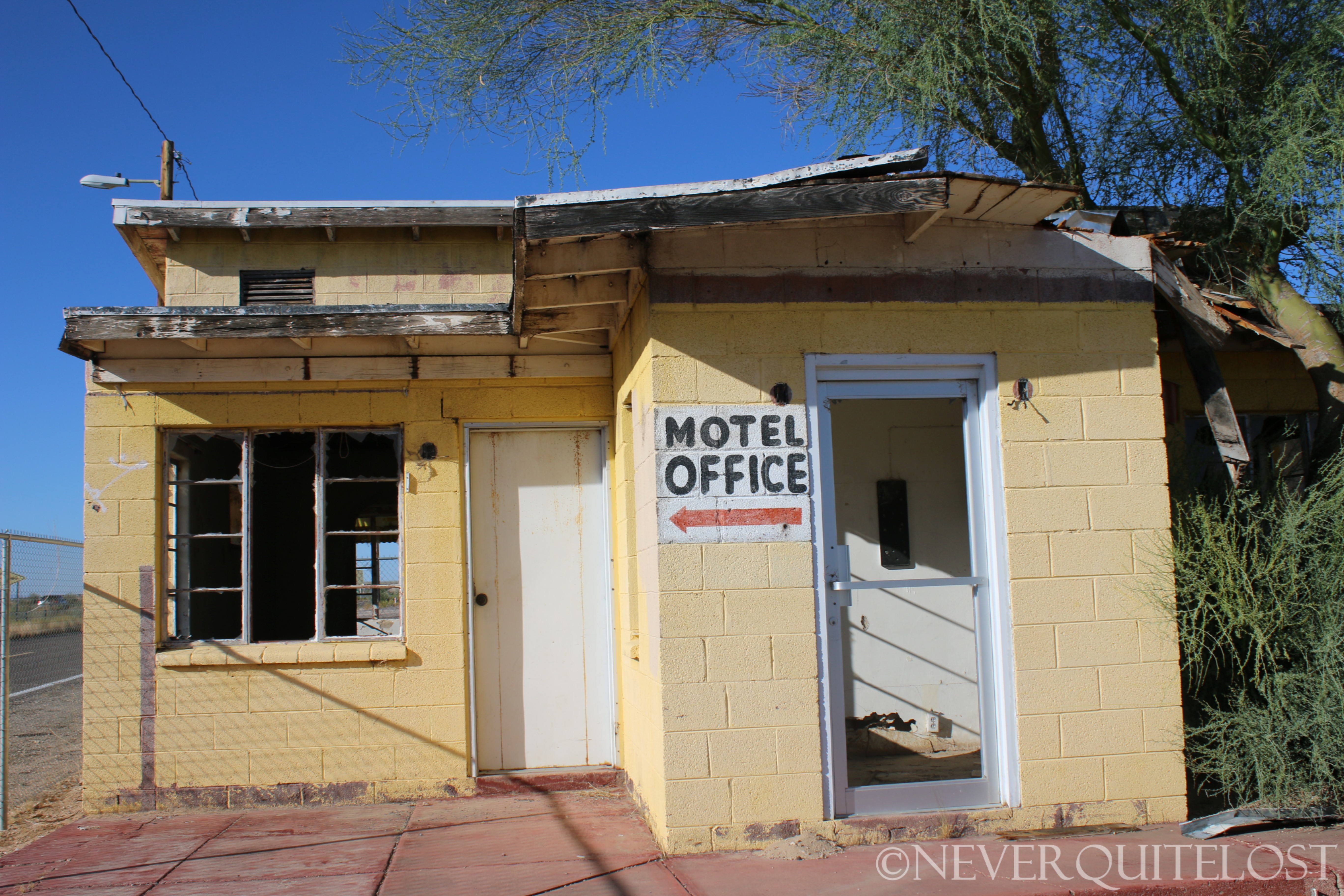
The Joshua Motel office.

Just south of the well-known MOTEL sign in Yucca, Arizona (all that remains of the Whiting Brothers motel which once stood there) was the Joshua Motel and Sandy’s Café. The Joshua was a small place, just eight rooms, but it had the advantage of being right on Route 66 – at least until Interstate 40 slashed through the middle of Yucca. It was probably built shortly after Route 66 first came through Yucca back in 1952.

The Joshua Motel office to the left and its first two rooms.

Next to the Joshua was Sandy’s Café which seated 38 people. It seems that life was a constant struggle for Sandy’s, its lease seemed to be constantly up for sale. In the 1960s it was modified to also serve as a drive-thru and to drum up trade. But when I-40 opened in the early 1970s it was the end of the road for the Joshua Motel and Sandy’s Café. Traffic rolled onto Kingman or Needles to find a bed or a meal. The motel staggered on for a while; in 1977 it was being marketed with a desperate air and a knock down price as a potential nursing home. When I first saw it, old petrol pumps were being stored in the office.

Sandy’s Cafe. The sign once boasted neon lighting but that was gone long ago.

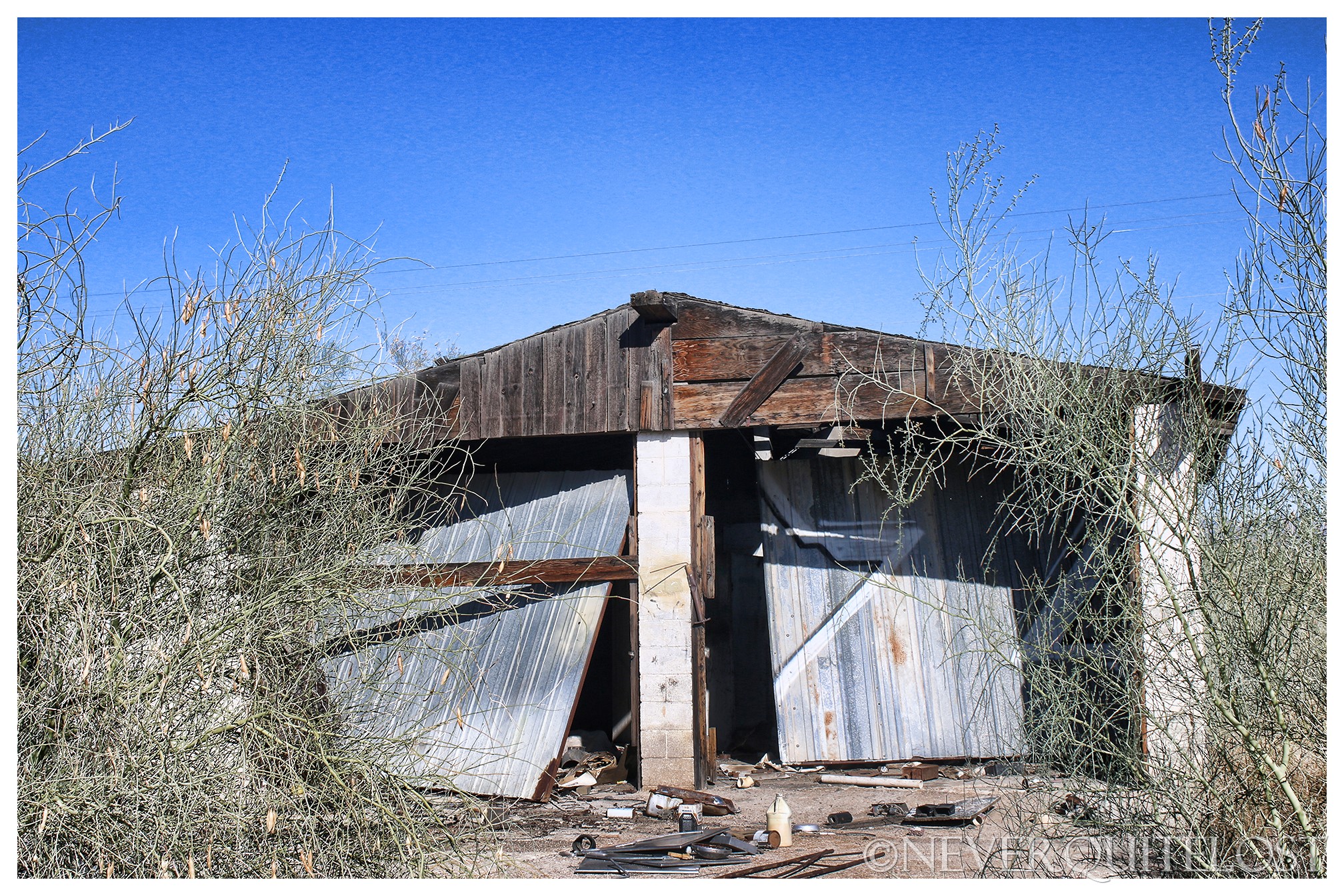
A little way south, on the other side of Guthrie’s Service Center, stands Yucca’s most famous landmark (although it’s a toss up between that and the Dinesphere), the truck on a stick. It used to have buildings around it, a large roofless block building and an older wooden workshop, not to mention a house with various derelict cars and buses around it.

Ran when parked?

In the spring of 2022 the Joshua Motel and Sandy’s Café were demolished. The neighbouring land around the truck on a pole has been cleared and scraped, leaving the Peterbilt in not so splendid isolation and the entire acreage up for sale. It is, according to the realtor, ‘a great location for RV park, boat shop, restaurant, off road rental, and so much more’. But, although it’s only been on the market for two months, the price has already been dropped by $40,000. And so another little piece of Route 66 history disappears.

Very many thanks go to out to Lara Hartley Roberts for spotting that the motel and café had gone. (See Lara’s wonderful photography at www.flickr.com/photos/redshoesgirl/)

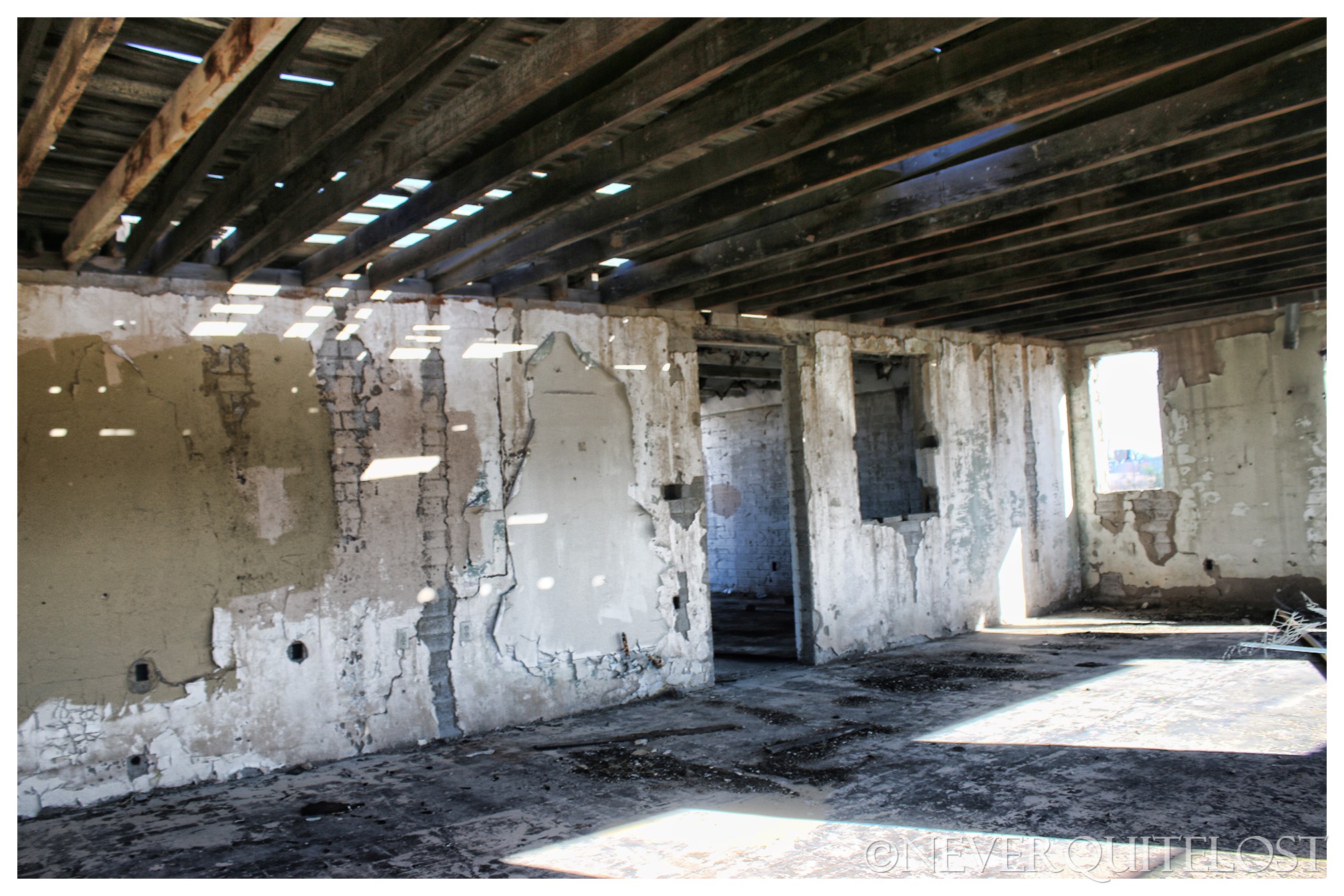
Considering the place had been abandoned for 30 years, the bathrooms had held up quite well.

This garage stood in front of the truck on a pole.

The interior of Sandy’s Cafe.

This garage stood in front of the truck on a pole.

The Joshua was always small, only ever eight units.

THE AXE MURDERER OF TUCUMCARI

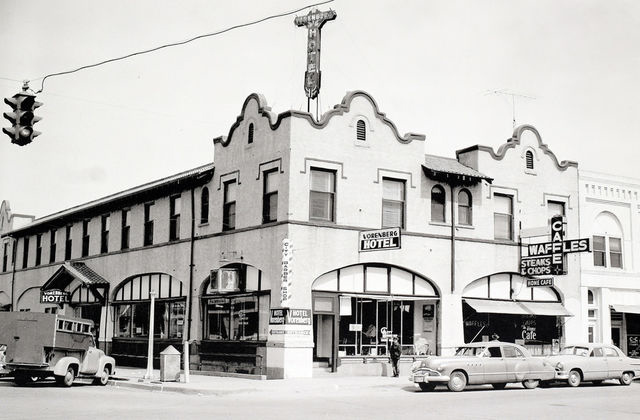
18 December 1947 was a cold winter’s morning like any other in Tucumcari. Bertha Eugene Wagnon Kappel had got up at 4.45am to prepare for her shift at the Home Café in the Vorenberg Hotel. (The Vorenberg was a grand hotel in downtown Tucumcari which boasted suites with private baths, a large lobby, dining room and barber shop as well as the Home Café. After the First World War it was owned by Floyd B Redman who built quite a property portfolio over the years. In the 1950s he bought another motel which was managed by a lady called Lillian Leigon; romance blossomed and he presented the motel to her as an engagement present. The motel was the famous Blue Swallow.)

The Vorenberg Hotel. The Home Cafe where Bertha Kappel was employed can be seen at the right.

Bertha had only been working at the Home Café for a couple of months while her husband Gus Adolph did various odd jobs. They had been married in Oklahoma in 1938 but several of the family – Bertha was one of 13 children – had moved to Tucumcari where Adolph also had links. They and their daughter were staying with Bertha’s brother, Roy, and his wife Catalina, in Roy’s home on North 1st Street, although the Kappels had purchased a lot nearby on which they intended to build a rudimentary house. To this end, Bertha had bought some lumber and, after finishing work on 17 December, she visited the lot to inspect progress. She found that the lumber was missing and this set into inexorable motion the events of the next few hours.

Bertha returned to her brother’s house and accused Adolph of selling the materials. He denied it but she discovered that he had, in fact, sold the lumber to a neighbour and, even worse, he hadn’t been paid for it. Bertha told him to get the lumber back within three days or “she would turn him in”. Now, the lumber may have been from a dubious source and Kappel did have a prior conviction for theft, so it might have been a well-aimed threat on her part. The quarrel continued into the evening although Adolph would later claim that the couple had been made up by the time they went to bed.

Even before the lumber incident it doesn’t appear to have been a happy marriage. Bertha had moved to Tucumcari some eight months before while her husband tried to find work in Oregon. When he returned to New Mexico she had sworn out a warrant on him for non-support of their 12-year-old daughter, Mary Frances.

Unsurprisingly next morning, the arguing flared up again when Adolph was slow to accompany Bertha on her walk to work. She left the house without him and when he called out to her to wait, she replied; “You dirty son-of-a-bitch, if you are going with me, come on.” It was an unfortunate choice of words and Bertha probably knew that it was a term that particularly offended her husband.

At around 6am, near an overpass, the body of Bertha Kappel was discovered just three blocks from her brother’s house. She lay in a pool of blood, her head cracked open by three blows from an axe and her left ear almost severed. When she was found, Kappel was taking a nap, having returned home, vomited and then taken two aspirins for a headache and then slept for an hour. When he woke up, he had a hearty breakfast and then went to the Home Café to say that his wife wouldn’t be coming to work that day. He was then arrested close to where Bertha’s body lay.

kappel-1

Adolph Kappel had a limited mental capacity but he knew enough to get rid of the axe, tossing it onto the roof of a neighbour’s house where it was later found. He signed a confession, saying that he had no recollection of killing his wife but remembered “I was standing over her and I struck a match and seen what I had done.” At his trial, he was charged with first degree murder and the jury took less than an hour to find him guilty. He was sentenced to be executed in New Mexico’s electric chair.

Kappel appealed and was granted a second trial on the grounds that the jury had not been given the option of convicting him of second degree murder. This jury decided that the murder had been conducted in the heat of the moment and was not planned or deliberate. He was once again found guilty but this time the sentence was 90-99 years rather than death. Kappel proved to be a model prisoner – for at least a year…

Gus Adolph Kappel

Assigned to a prison work gang at the penitentiary’s clay pits, on the last day of October 1950, Adolph Kappel made his escape aboard a black mule called Pete (one newspaper reported the beast was called Pegasus which seems a little fanciful). For five days he managed to stay ahead of police and prison guards in freezing cold weather until he was finally captured 35 miles south east of Las Vegas, New Mexico. He gave various reasons for his escape, saying that he had wanted to find out why he hadn’t heard from his daughter and believed that his brother was preventing her from writing to him. He also said he wanted to see his sister-in-law who had been involved in a road accident and then intended on going to Oklahoma to visit his mother and other relatives. But he also told reporters that “I am not the man who killed my wife” and that had he been able to get to Tucumcari he “could have cleaned up the whole mess”. Given that he had signed a confession which formed the basis of his first trial and pleaded guilty to second degree murder at the second trial it’s difficult to see how anyone else might have killed Bertha.

In 1953, Governor Edwin Mechem commuted Kappel’s sentence to a flat 70 years while the Warden commented, perhaps a little tongue in cheek, that Kappel was “now a plumber. He does not have access to a mule”.

Governor Erwin L Mechem who commuted Adolph Kappel’s 90-99 sentence to 70 years.

Adolph Kappel applied for parole at every chance and was denied for many years. When was he released? The short answer; I don’t know. He died in 1978 at the age of 63 and is buried in the Santa Fe National Cemetery. However, he was also incarcerated in the Penitentiary of New Mexico which is just 15 miles from Santa Fe but I found that he had won a newspaper competition in 1976 when living in Ojo Caliente near Taos so it appeared he stayed in the area after his release. Perhaps he just had nowhere else to go.

John Frederick Kappel whose bound body was found in a Sayre lake in an unsolved homicide.

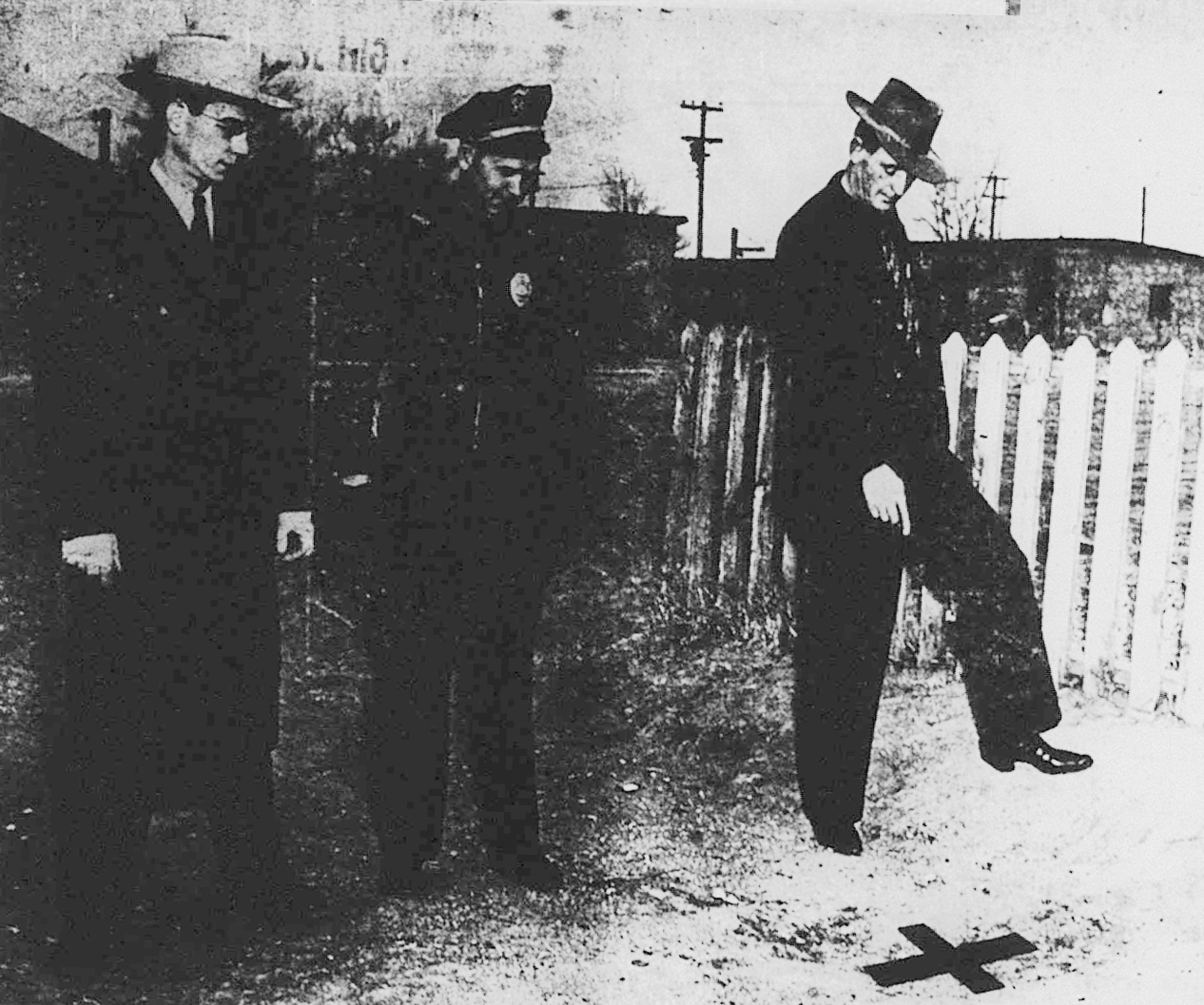
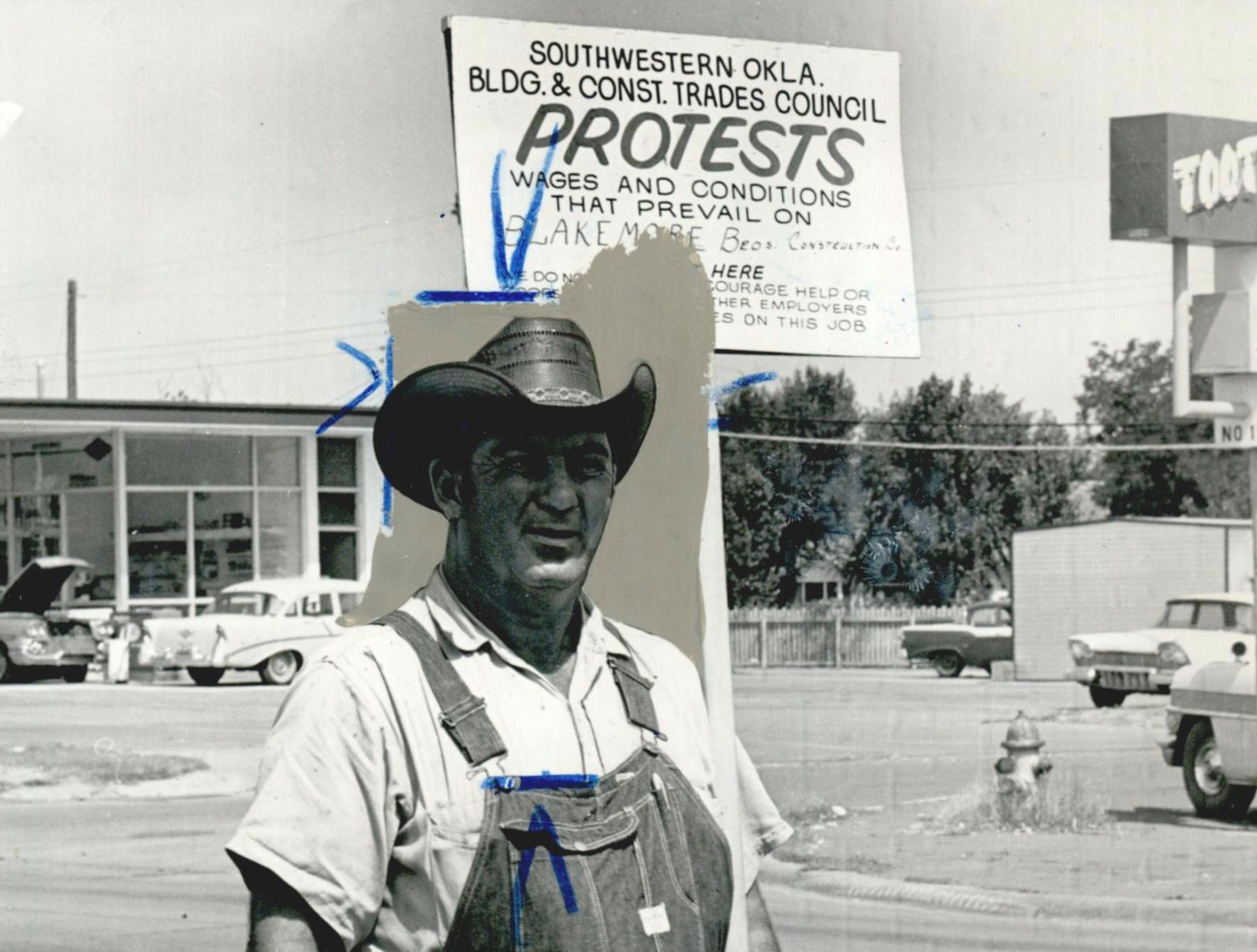
It is perhaps a little ironic that, with one brother behind bars for homicide, another brother should also meet his end by murder. In September 1963, the youngest Kappel son, John Frederick, was found floating in a pond in Sayre, Oklahoma. This was no natural drowning; John’s hands and feet were tied and he had also suffered a blow on the head before being thrown into the lake to drown. He had previously been working as a union picket for the International Hod Carriers, Building and Common Laborers Union protesting at the construction site for a grocery store in Elk City. Police stated that his job had nothing to do with his death, although they were bemused at the lack of signs of a struggle as John was a large man – 6’4” and 240lbs as well as being a karate expert – and throwing him in the pond had required lifting him over a barbed wire fence. The case was never solved.

The lower walls are all that remains of the Vorenberg Hotel after a fire in the 1970s. The house where Bertha and Adolph were living with her brother is also long gone.

THE FINAL MYSTERY OF ED’S CAMP

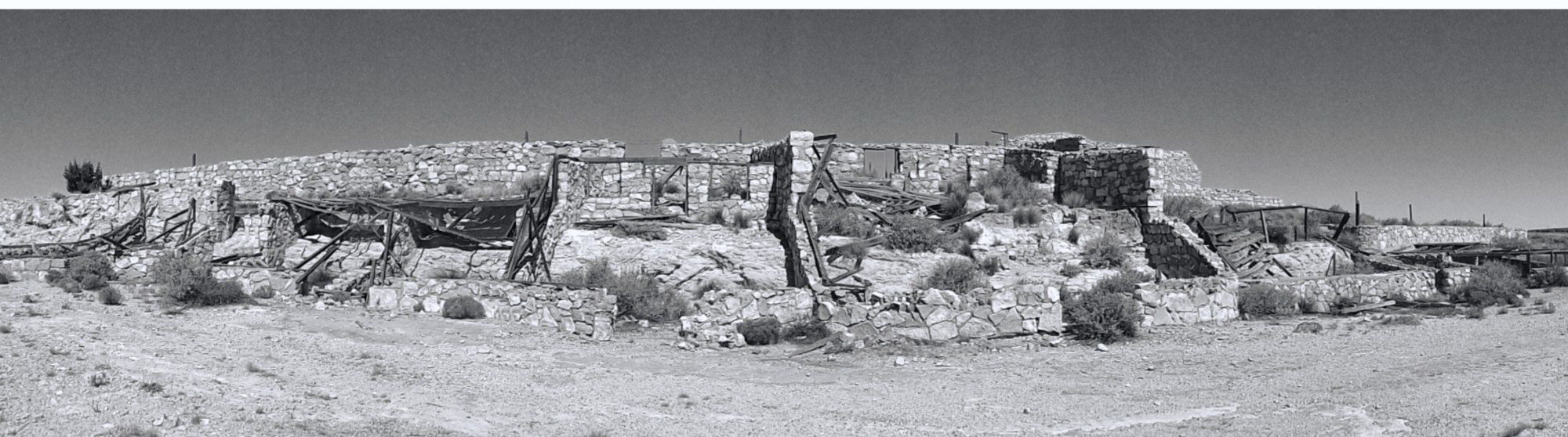
Ed’s Camp looks very much as it did when he passed away well over 40 years ago. That’s because it is clearly out of bounds, please respect that.

Ed’s Camp, east of Oatman, Arizona, at the foot of the Sitgreaves Pass, is fascinating for the man who was the only owner; Lowell ‘Ed’ Edgerton, a man of both enigma and mystery who has left behind him one final puzzle.

Edgerton was born in Michigan in 1894 and headed west as a young man on the advice of his doctor. Edgerton had suffered from tuberculosis which, at the turn of the 20th century, was the leading cause of death in the United States – he claimed exemption from the draft in World War I as a consumptive. Initially moving to southern California, he found the climate of Arizona more to his liking and he would spend the next sixty years of his life in Mohave County.

Little is known about Edgerton’s early years in the West and many of the stories he told throughout the years should probably be taken with a healthy dose of salt. Later he would claim that he had begun to train as a doctor (he did study for a short time at the University of Michigan although that was in engineering) and had, while working for a mining company in Mexico, amputated a man’s leg during the Mexico revolution of 1910-1920. He told stories of how he had owned a mansion in Los Angeles but had lost it in a property deal that went bad. He also claimed that, while tracking a mountain lion, he followed the beast into Nevada and became so engrossed in the hunt that he forgot about his wife and five children and figured there was no point in going back. There’s actually no record of Edgerton ever having been married, let alone having a brood of five children!

When he moved to the Oatman area, he was able to pick up the lease on the tailings dump of the Oatman works, tailings being the by-product of the mineral recovery process, the material left over after the valuable ore has been separated from the uneconomic material. Within months, his operation was making more money than the whole mine and he was then hired by the Tom Reed Mine as foreman of recovery. Around 1919, Edgerton bought a parcel of land at Little Meadows in the foothills of the Black Mountains in north west Arizona. The site had been known to Europeans since 1776 when Father Francisco Garcés, a Spanish missionary and explorer, paused here on his expedition across the south west of America, while it became a staging posting for future treks, including that of Lieutenant Beale. The attraction of Little Meadows was that it had that commodity which could be worth as much as gold: water.

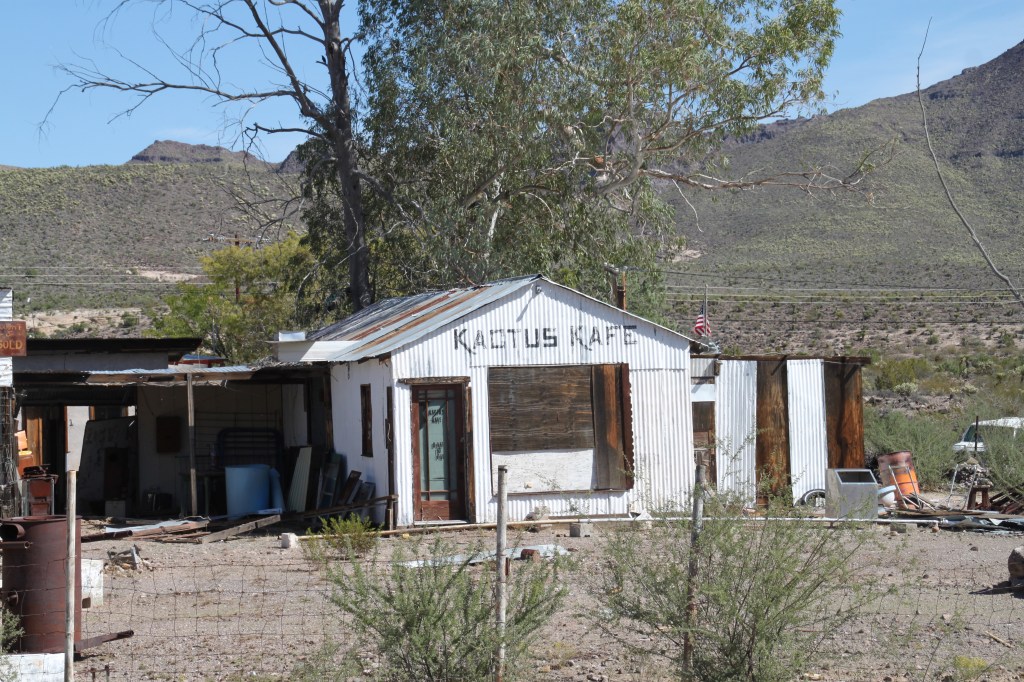
The Kactus Kafe was the first building that Ed put up on the site.

Initially, like so many who rushed to the area at this time, Edgerton’s intention was to make his fortune through a gold strike. With his older brother, Tibor, he took on a number of mining jobs until he realised that he could make a steady (and easier) living catering to travellers and miners than digging into the mountains. His trading post was little more than an open space with a tin roof – he later said that, with the inauguration of Route 66 in 1926, traffic became so busy so quickly that he never had time to add walls! As Tibor returned to Kalamazoo, Michigan, to open a tea rooms, Edgerton added the Kactus Kafe (this time a proper building) and a gas station and called the place ‘Ed’s Camp’.

At first Ed’s Camp had no tourist cabins or rooms. Instead, travellers could pitch a tent or sleep in their cars. For those who wanted a little luxury and had a little more cash, there was a screened porch where they might sleep on a cot. Just as NR Dunton did at Cool Springs, Ed charged for water on a per bucket basis although that fee was waived if people paid to stay. As the place grew, a grocery store and souvenir shop were added and Ed’s Camp became a stop for Pickwick Stage Lines, a coach company that would become part of the Greyhound bus empire.

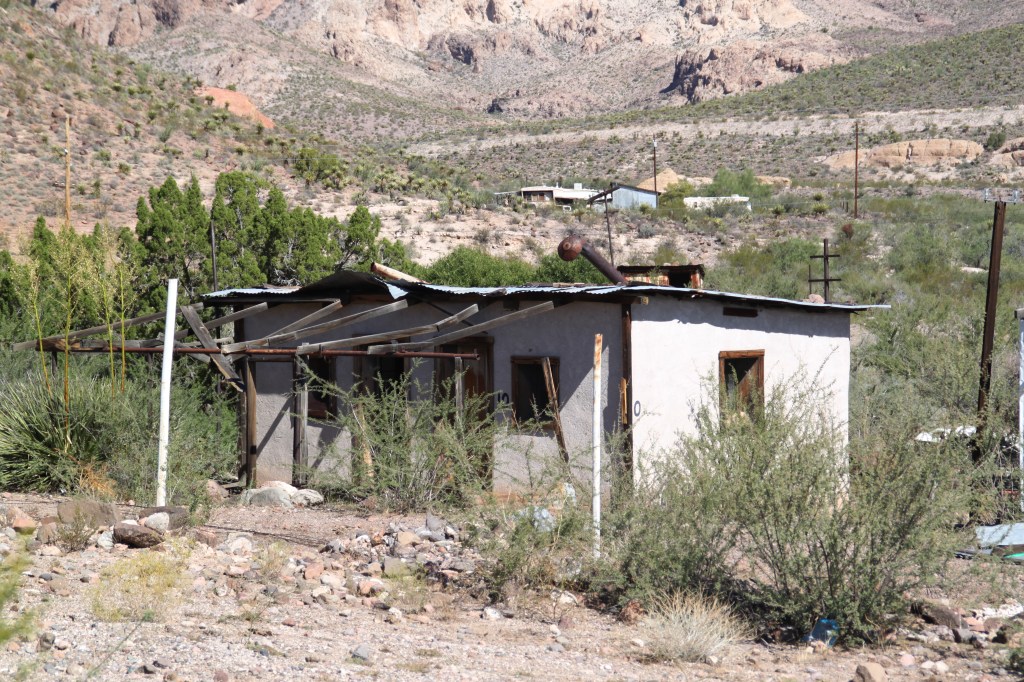
One of the surviving cabins.

But Ed Edgerton was far more than just a store and gas station attendant. Over the years, he studied the rocks of Arizona and became an expert geologist who could identify any Mohave County rock and say, to within a few miles, from where it had come. He proudly told people how he had met Marie Curie, the French-Polish physicist – a claim which is quite possible as Curie toured the United States in both 1921 and 1929.

Edgerton owned and mined a rare earth mine from which he extracted ore that was shipped to a variety of companies, providing some thirty different minerals that were used in alloy steels, electronic components, ceramics, plastics, atomic devices and even cosmetics. He even, if only briefly, had a mineral named after him, although Edgertonite, an oxide of oxide of iron, yttrium uranium, calcium, columbium, tantalum, zirconium, tin, and other minerals  was quickly renamed Yttrotantalite when it was realised it had already been discovered in Sweden in 1802. It is, however, quite likely that Edgerton was the first man to find Yttrotantalite in the United States and he would say that he had provided the material for the first atomic bomb. Truth or fiction? We shall probably never know.

Edgerton credited Yttrotantalite with saving his life. According to him, on 17th April 1957, doctors told him he had cancer. They gave him thirty days to live unless he had major surgery. Edgerton declined the operation and returned to Ed’s Camp where he decided he would treat himself. The story changed in some details on each retelling, but this is probably the most comprehensive description to survive: “I put on two suits of heavy woollen underclothes and put these swatches [of Yttrotantalite] in between, all around, and then I put three big electric pads around that. I cooked myself for about seventy-two hours at one hundred and thirty degrees. I didn’t eat anything, I drank warm water. At the end of seventy hours stuff began to loosen inside me … Rotten goddamn stuff, it couldn’t take the heat. I commenced to bleed internally and for up to ninety hours I bled inside – rotten blood first and then fresh blood – and then that quit.

After that, Ed Edgerton nursed himself back to health on a diet of goat’s milk, raw eggs and avocadoes. Two months later, his doctor declared there was no sign of cancer in his body and it was a miracle. Although it’s tempting to believe that it would be difficult for anyone to survive such extremes of temperature for so long, not to mention four days of internal bleeding, Edgerton believed that he had cured a cancer and instead of having just a month left on this planet, he lived for another thirty years. He claimed that he was studied intensively by the Veterans Administration Hospital in Fort Whipple, near Prescott, although there are no records of Edgerton having been a patient until he died there in 1978. He also told people he had worked with one of the foremost cancer experts in the world – although he declined to name the scientist – as well as claiming that he could predict where in a person’s body a cancer might be just by the colour of their hair.

It would be tempting to dismiss Ed Edgerton as a crazy old desert rat, telling tall tales in the best tradition of a hermit. But Edgerton was far from that. While some of his stories may have been embellished – and others, quite frankly, tongue-in-cheek fabrications created to entertain visitors – he was much respected in the fields of geology and mineralogy, despite his lack of formal training. He took on consultancy work for companies, taught in the local college and wrote and presented papers on minerals. Edgerton was certainly not a hermit although much about his life remained a mystery. In 1948 he ran for the office of state senator in Mohave County on a Republican ticket (although he was beaten by the Democratic candidate, C Clyde Bollinger) and he trained to be a census enumerator for the 1960 US Census, a job his father had also done in Michigan sixty years earlier.

Thanks in part to the natural springs and in part of the improvements that Edgerton made over the years to the water flow, Ed’s Camp truly became an oasis in the desert. Late into his seventies, Edgerton kept Kingman supplied with pears, as well as growing apricots, tomatoes, quinces, strawberries, peppers, corn and grapevines. His pomegranates were so good that they won four ribbons at the Arizona State Fair! He even managed to keep alive a huge saguaro cactus which stood for years just by the gas pumps. It eventually attained an impressive height and several arms before dying around thirty years ago.

On 7th September 1978 Ed Edgerton died at the age of 83, not as he would have surely wished at the place he had called home for most of his life, but in the VA Hospital in Fort Whipple. His obituary mentioned only that he was a ‘retired miner’ but Lowell Edgerton was so much more than that. Today Ed’s Camp is gently decaying although the rigid enforcement of those NO TRESPASSING signs mean that he would still recognise the place. The gas pumps and cactus are long gone but the makeshift trading post and the café remain, while you can catch a glimpse from Route 66 of the basic tourist cabins he built. Squint hard at the hillside opposite and you might just make out the few remaining white stones that once spelled out Ed’s Camp. Now it seems a bleak spot in the desert but for much of the last century it was paradise for Ed Edgerton.

But Lowell Leighton Edgerton leaves behind one last mystery. Just where is his final resting place?

The Findagrave web site has him listed being buried in the Mountain View cemetery in Kingman, which would seem logical. So just a few weeks ago I took a walk around to see if I could find his grave. When I had no luck, I wondered whether it was unmarked, so I sought the assistance of the cemetery staff. They were very helpful and hauled out large leatherbound ledgers which list all of Mountain View’s ‘residents’. Finally they looked up and said, “He’s not here.”

As Ed died in a VA hospital I considered whether he would been buried by the Veterans Administration in Prescott. But, after combing through VA records for all of its Arizona cemeteries and burials, I drew a blank. I widened it to a nationwide search (although it seemed supremely unlikely he had been taken back to his home state of Michigan) and the end result? He wasn’t there.

Wherever Lowell Edgerton was laid to rest, he’s keeping it to himself – and I think he would rather have liked that.

These cabins were the height of luxury at Ed’s Camp!
In front of Ed’s Camp once stood the gas pumps and a saguaro cactus.

GOODBYE DESERT CENTER

The café and service station in Desert Center has long been one of my favourite stops, although it’s been shut up for years. The café has remained just as it did on the last day of business in 2012, with condiments on the tables and coffee mugs on the counter. For years a note on the door informed customers it was temporarily closed for building maintenance.

The iconic neon sign of the Desert Center Cafe.

The only food place for 50 miles, the café and service station was built by town founder Stephen A Ragsdale in 1921 and his advertising for the café claimed ‘We lost our keys – we can’t close!’, a boast that the café had been open 24 hours a day, 365 days a year since it opened. Desert Center went onto become the birthplace from which Kaiser Permanente, the world’s largest managed health care system, would rise. Despite being a noted businessman, Ragsdale’s reputation was shot down in 1950 when he was accused of a dalliance with one of his employees and he retreated to a log cabin in the mountains where he lived out his days. The café, meanwhile, featured in films and adverts and even a video game, but it never reopened after that final day seven years ago, I-10 rushing by just yards from its back door.

The bar stools sold for $300 and everything behind the counter (except for the milkshake machine) for another $300.

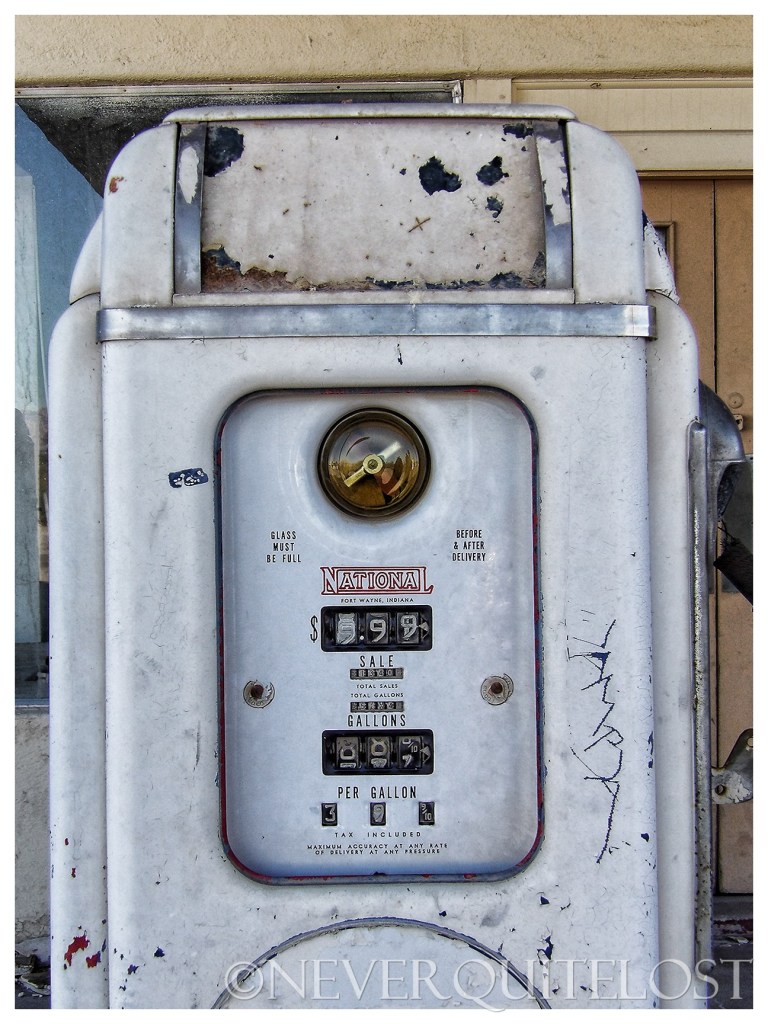
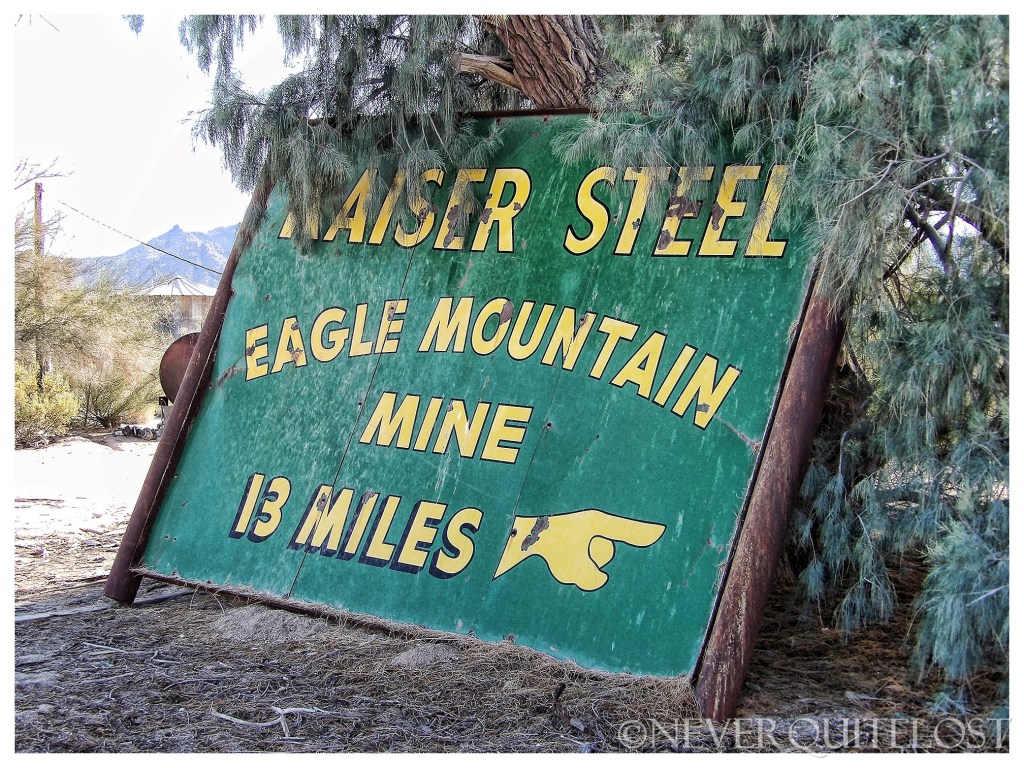
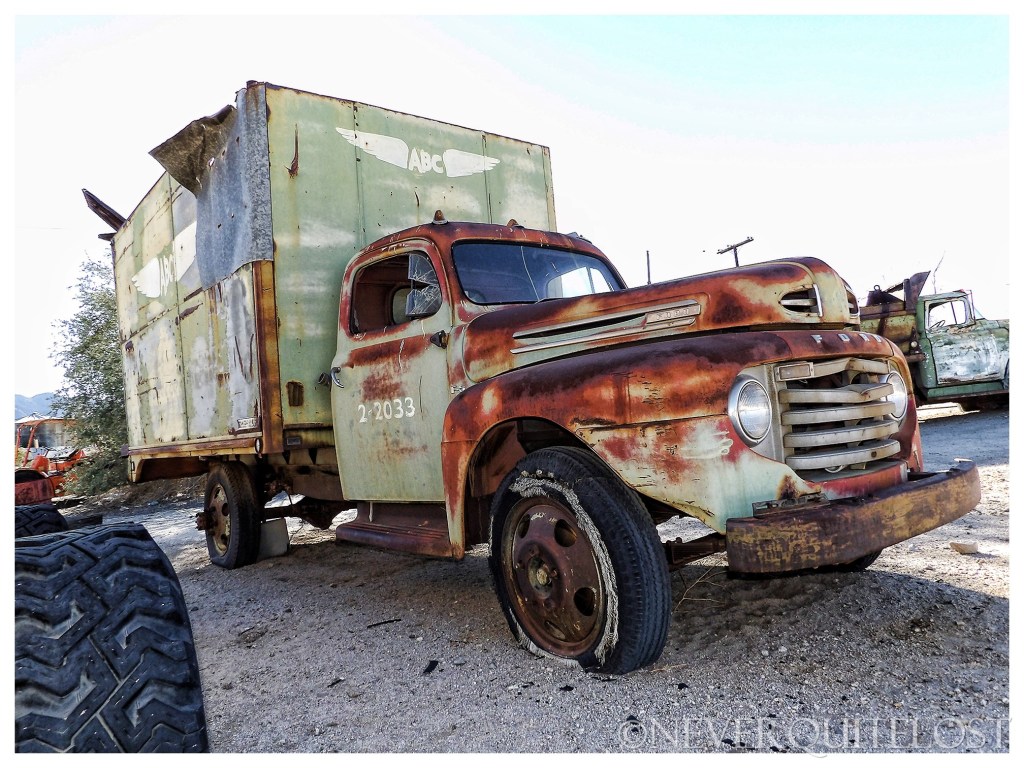
Last weekend, almost all the contents of the Desert Center Café and Service Station (not to mention the farm equipment and the cars in the junkyard which also belonged to the late owner of the town, ‘Desert Dave’ Ragsdale, grandson of Stanley) were auctioned off in an online estate sale, including the old cars and replica of a train that you could only previously see by peering through the dusty windows or holding a camera up to the window. The classic cars or the American LaFrance fire engine didn’t make much money, although the porcelain Eagle Mine Mountain sign that has been outside for years raised $3300 and four Texaco hand cloths printed with the Desert Center address made $250. The seven gas pumps which stood outside the service station made a reasonable $3300, but the wonderful old neon sign sold for a seemingly paltry $7400. You could have bought a a full-size wood and fibreglass replica of a Southern Pacific GS-4 steam locomotive, built as a prop for the film Tough Guys, for just $130. A Coke vending machine went for a mere $10, but a Los Angeles Times newspaper rack for $270. The nine bar stools which, the last time I was there, still butted up to the counter, fetched $300. Behind the counter, the whole backline of stainless steel tables, cupboards, Kelvinator freezer, soda fountain and coffee maker made $300, the whole kitchen set-up including the stove, fryer, griddle and prep stations just $375. Another lot consisting of deep friers, ovens, refrigerators, various cooking utensils, steamers and a deep freezer fetched just $40.

And there it is, everything gone from Desert Center, every last glass, every bit of scrap metal, every sign the café and service station ever existed. I guess they found those keys after all.

One of the seven National pumps which stood outside the gas station and were sold as a group lot for $3300.
The cafe had remained untouched since it closed in 2012. The wooden phone booths in the background sold for $1500.

This sign had been propped up against a tree at the back of the cafe for years. It fetched $3300.
This sadfaced 1959 GMC 550 dump truck made $700.
The 1950 Ford cargo truck saw $1400.
I knew where this porcelain sign was and I’m surprised it had escaped the light-fingers, but it made $800.
If you’d wanted a plywood replica of a train – and a movie prop no less – this one would have set you back just $130.
This 1948 caboose was one of the big sellers (the biggest was a 1930 Indian motorcycle which reached $42,000), going to a new owner for $4500.
This sign wasn’t listed in the sale so perhaps it had already ‘found’ a new home.
Neither were the tables and booths listed for sale, indicating that they will just be ripped out when the building is demolished as no doubt it will be at some point in the future.
Goodbye Desert Center.