BEHIND THE NAMES ON THE TEXOLA STONE: Part One

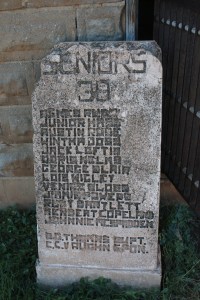
The ‘Seniors 38’ stone outside the one-room jail in Texola.

On 4th and Main Street, a stone’s throw off Route 66 in Texola, Oklahoma, is a single cell jail. But what is even more interesting is the gravestone-shaped marker that has been propped up outside the jail for years. The names of it are, it says, the ‘Class of 38’. But are they? Well, yes and no.

Texola may be a ghost town now, but it once had a thriving high school, complete with baseball, football and basketball teams, Glee Club and even a school newspaper (the ‘Texola Booster’, first published in November 1919). Texola High School had an auditorium which was used for plays and operas and, at its height had over a hundred pupils. By the mid-1930s, the enrolment was around 65, and, as far as I can make out, the last graduation was in 1957.

The Texola jail.

But it’s that curious stone that has always intrigued me. What happened to the boys and girls whose names appears on that plaque, so I set out to find out. What I soon discovered was that this wasn’t simply the Class of 38. One of the youths – Jimmi Powers – was actually in the Clas of 1939, while Herbert Copeland never had the chance to graduate at all. It soon became clear that this was too long for a single blog post and it will therefore be divided into several parts; so, in the order in which the names appear, this is the Texola stone’s ‘Class of 38’.

AGNES RUDD

Agnes Telitha Rudd was born in Erick, Oklahoma on May 6, 1919, to Thomas and Lela Rudd, the second of their two daughters. It was to be a childhood blighted by tragedy. On April 9, 1928, when Agnes was just eight years old, her sister Clora Viola, older by 18 months, died of measles. Clora left big shoes for her sister to fill; Her parents considered she was a saint – before she fell ill she had been top of her class at school, while her obituary spoke of how she read her Bible each day and after she was too sick to read it, she had her mother read it to her. It was said of Clora, “If she could not say something good about anyone, she did not say anything.”

Almost exactly 19 months later, Agnes’s father died in November 1929; Thomas Rudd was just 34 years old. Agnes and Lela had no option but to move in with her grandparents. At the age of 19 she married Wesley Don Lake who had left school after the 5th grade in elementary. A year later they were renting a house in Texola; Wesley worked as a gas station attendant while Agnes stayed at home. Wesley was called up on December 26, 1942, to the 704th Training Group Air Corps in Atlantic City, but he only served six months.

Agnes Rudd

Agnes and Wesley moved to Amarillo where they both took jobs with International Harvester Co, Agnes as a machine operator and Wesley as a parts man. If they wanted children, they never came. And it seems they did, for in 1962, when Agnes was 43, they adopted a baby they called Don Wesley. Wesley was a warehouseman for Sears Roebuck Co But tragedy would strike Agnes again; when little Don was just three years old, Wesley died of a massive heart attack. He was just 50 years old.

Throughout her life, Agnes’ love of poetry sustained her. It might seem a little mawkish by modern standards – after her grandmother’s death she wrote a long poem that started:

Dear loved one we’ve missed you so

We’ve wondered oft times why you had to go

You left a vacancy that can never be filled

For with your presence we were always thrilled.

However, it gave her comfort and she enjoyed gifting poems to family and friends. She never remarried, although she lived to see Don and his wife Shawna give her three grandchildren. Agnes died in Amarillo on July 8, 2002.

JUNIOR HASS

Hugh Harrison Hass was born in Texoma, Oklahoma, to Hugh Manuel Hass and Jamie Clara Lackey-Hass on November 27, 1920, but he was always known as ‘Junior’. By the time he graduated from Texola High School in 1938, his father was a deputy sheriff. Junior went on to attend Panhandle University A&M (Agricultural and Mechanical), now Oklahoma State University. There he excelled in sports, starring in all the major athletic events.

Hugh ‘Junior’ Hass in 1938.

But Junior had an urge to fly. In 1941 he completed a primary flight course at the Texhoma CPT School and gained his pilot’s license, going to Amarillo the following January to join the civil pilot training course there.

By June 1942 he was employed as an instructor in the Cutter-Car Flying Service in Albuquerque, graduating to assistant flight instructor. When Uncle Sam called, it was inevitable that Junior would take to the air. He served in the United States Navy, training cadet fighter pilots in Norman, Oklahoma, as well as being stationed at the Glenview Air Station in Chicago.

Following his discharge he returned to Cutter Car Flying Service and then working for Texhoma Flying Service and Catlin Aviation in Oklahoma City, flying both charter and crop dusting planes. There was a stint with Standard Airways and as the personal pilot for the Tulsa Oilers hockey team, while he finished his flying career in 1990 after 13 years working for Aerial Photo Service in Tulsa.

Then he took on a second career, owning and managing a bridal shop called Joy’s Klothes Kloset. He was a man who always wanted to be busy and constantly learning; he taught himself Spanish and German and travelled widely to Europe, South America and the Galapagos Islands. When not working or travelling, he raised funds for various causes and was an all-round good guy.
On July 29, 1945, he had wed Leatrice Joy Richerson who hailed from Sayre, Oklahoma, and a few months before his death, they had celebrated 63 years of marriage, a union which had produced a son and three daughters, one who predeceased him. Junior Hass passed away on November 2, 2008.

MURDER ON MAIN STREET IN ALANREED

It was a quiet night in Alanreed, Texas. Perhaps a dog or two barked at the automobile weaving its way down Main Street; cars were still a novel enough sight for the canine population to call attention to each one, but those automobiles provided a living for Tobe Clodfelter who ran a garage in town.

Tobe Clodfelter’s garage in Alanreed.

Given his trade, it was probably Tobe at the wheel that May night, accompanied by his friends, Joe Hayes, a labourer from Alanreed, and Roy Tipton, a farmer who lived a few miles outside town. The trio had been on a trip into the country for what was described as an entertainment – which could be anything from a shoot to a party and was probably both – at which, by all accounts, the three men had been heavily drinking. It would end very badly that night.

For Tobe the trip and the accompanying libations were probably a chance to let off steam, away from the pressures of running his own business and providing for his two young daughters. At 30, he was the oldest of the three men and the only one to be married, having wed his wife Vallie when she was just 14.

The very young and beautiful Vallie Agee, soon to be Mrs Clodfelter.

Vallie and Tobe had both grown up in the Chickasaw Nation of the Indian Territory (the state of Oklahoma would not become part of the Union until 1907) and, in 1900, the Clodfelter family had applied to become recognized as Missouri Choctaws. His mother Mary claimed to be 1/8th Choctaw, making her only son Tobe and his seven sisters 1/16th Choctaw. It is unlikely this had anything to do with ancestral pride and everything to do with the idea that they would be then be able to claim land or money. There were countless fraudulent claims at the time by people claiming to have ‘Indian blood’ in order to be allocated land and it’s all too likely that the Clodfelters were among those. In any event, in 1902 the claim of Mary and her children to be Choctaws was resoundingly rejected.

The Clodfelter family. Tobe is in the centre, flanked by his parents Newton and Mary and his six sisters. It’s likely this photo was taken around 1894 or ’95 when Tobe was about 9. One of the sisters, Lulu (on far left) would die in 1901 at the age of 16 while another, Mildred (‘Birdie’) was born in 1897.

Tobe and Vallie moved to Alanreed after their marriage in 1905 at a time when the town was growing. It had a hotel, a bank, Baptist and Methodist churches, two grocery stores, a hardware store, a blacksmith’s shop and, in 1912, a new two-storey school. In July 1906 their first daughter, Audrie Mae, was born, followed almost two years later by her sister Arble Faye.

26-year-old Roy Tipton was, in 1916, farming with his brother Charles in Gray County, while Joseph Hayes, the youngest of the three men at 22, got by with general labouring work. The Hayes family was still recovering from the death of Joe’s older sister, Sarah, the previous year. Her death certificate stated she had been suffering from pellagra (a nutrition-related disease which was prevalent in Oklahoma and Texas in the early years of the 20th century) for the previous three years. She had died at the age of 30, leaving three young daughters under the age of six.   

In the early hours of Friday May 12, 1916, as the men drove onto Main Street in Alanreed, an argument broke out. We will never know the cause of the altercation – and the fact the men were intoxicated no doubt exacerbated the situation – but Tobe Clodfelter brought it to a swift and savage end by drawing his gun and shooting his two companions. Roy Tipton fell dead, but Joe Hayes was still alive. With the last of his strength he fired back at Tobe Clodfelter. At 3.30am all three men lay dead in the street.

An inquest was held that morning and, at 4pm on Friday afternoon, the three men were buried in Alanreed Cemetery in a single ceremony conducted by the Methodist minister, Rev Howell.

A plain plaque marks young Joe Hayes’ grave.

It seems Joe’s younger brother Tom went off the rails after his brother’s death. Like his brother he had had little education, spending just three years in school. On May 29, 1917, despite pleading not guilty, Tom Hayes was convicted of stealing ‘one cattle’ for which he was sentenced to two years in Huntville prison where he died on November 8, 1918.

Although the gravestone reads November 11, Huntsville prison recorded his death as three days earlier.

He is buried next to his brother although, curiously, his gravestone gives his date of death as November 11. Tom’s older brother Sam also died young in 1935 of pernicious anaemia, a disease, like pellagra, brought on by vitamin deficiency. He was 46 and left two young sons.

Vallie Clodfelter in later years.

Vallie Clodfelter remarried ten months – probably a necessity for a young woman with two small children – to a man coincidentally called Sam Hays. (He was also from Alanreed and the same age as Joe Hayes’ brother but, while it might have made for a better tale, they were not the same man.) The marriage produced Bradford, a half-brother for Audrie and Arble, but ended in divorce within a few years. Vallie married again to JA Jackson on July 15, 1933, but also divorced him shortly afterwards. She moved to Pampa in 1938 where she rented out property and lived there until her death in 1976. Vallie is buried in Alanreed cemetery along with her eldest daughter Arble.

Arble and Audrie Clodfelter married brothers, Philip and Raymond Howard; Arble and Philip’s marriage lasted just a few months and they were divorced in 1922. Arble married again to Harley Hickman but that too ended swiftly in divorce with Harley dying of a coronary thrombosis in 1952, just as her sister’s husband, Raymond, would in 1958. Neither sister would remarry after that.

While Joe Hayes’ grave is marked with a simple plaque and Tobe Clodfelter’s with a simple and possible more modern stone, it is Roy Tipton’s memorial which attracts most attention and that, even almost 110 years later, resonates with the anguish of his family. A tall marble column, it is etched not only with the family name and Roy’s details, but with the stark words, ‘MURDERED IN COLD BLOOD’.

Roy Tipton’s gravestone.