Unknown's avatar

About Never Quite Lost

The roads that led somewhere and now go nowhere. The history that you see out of the corner of your eye. The flicker where past and present collide. The time and the road and the world that is never quite lost.

THE STRANGE TALE OF KENNEDY’S LINCOLN

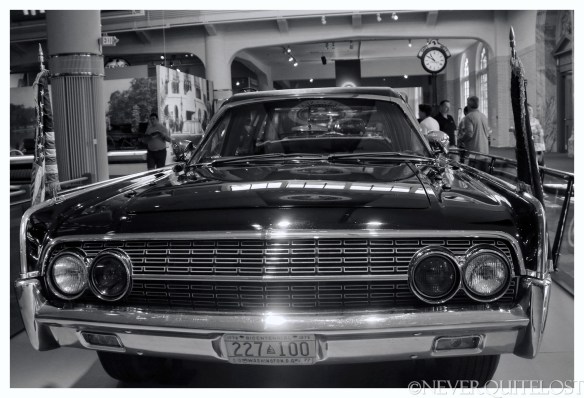
Although a 1961 model, the Lincoln was fitted with a 1962 grille before it went into official service.

It’s the most famous Lincoln Continental in the world, and for the worst of reasons. On 22nd November 1963, President John F Kennedy was shot and killed while riding in the back of this ’61 Lincoln in Dallas, Texas.

In the aftermath of shock that went around the world, you might presume that the car would quietly disappear, hidden forever in a secure warehouse or secretly crushed, watched over by men in black to ensure that curious workers didn’t try and salvage a piece.

Workers from coach builders Hess & Eichenhardt customizing the Lincoln for its duties with President Kennedy.

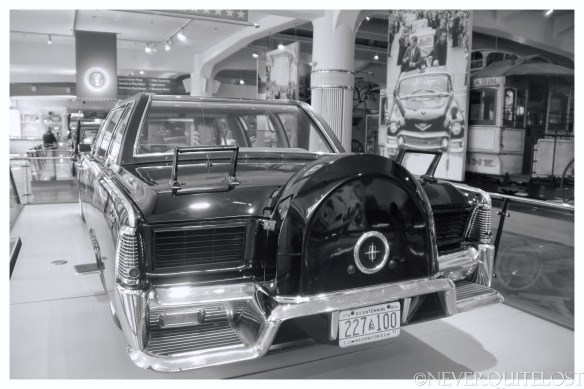
Nothing could be further from the truth. Instead, the stretched Lincoln was indeed spirited away by the Secret Service – but to be modified, fitted with a permanent steel roof (after Kennedy’s assassination, no US President would ride in a convertible again), with bulletproof glass. It would go back into the White House motor pool and be used for another thirteen years. Among those who rode in the car in which Kennedy died were Lyndon B Johnson, Richard Nixon, Gerald Ford and Jimmy Carter.


The Presidential limousine on duty in early 1963. Here the detachable rear roof is fitted. It had been removed in Dallas, although it wasn’t bulletproof anyway.

Why? Sadly, it seems to come down to cold hard cash. Although Ford leased the Lincoln to the government for a paltry $500, the work required to turn the stock convertible into a coach built Presidential vehicle, 41 inches longer than stock, did not come cheap. To replace the car would have cost $1.5 million in modern terms. Instead, just five months after JFK’s death, the Lincoln Continental was returned to active service, where it remained until 1977.


When the Lincoln – codename X-100 – returned to service in 1964, it had been fitted with a permanent steel roof, a more powerful engine, titanium armor plating and solid aluminium rims that allowed the tires to run when flat

THE GOLDEN DAYS OF THE TECHATTICUP MINE

All aboard for the Techatticup mine!

Long before neon lit up the sky of Las Vegas, people came to Nevada to seek their fortune. And, in the south of the state, many believed they would find that elusive goal in Eldorado Canyon.

The Spaniards first struck lucky in this area, 25 miles from modern Las Vegas, in 1775. But, despite naming it Eldorado, they found only silver on the banks of the Colorado and quickly decided that it wasn’t productive enough. It would be three-quarters of a century before they were proved wrong when Eldorado Canyon saw one of the first major gold strikes in Nevada. In fact, not only among the first but the most lucrative – over the next 87 years the canyon would reveal millions of dollars worth of gold, thanks to the Techatticup, Wall Street and Queen City mines which, in 1872 alone, produced $25.2 million of gold and silver. Montana, another gold boom state, in contrast produced a mere $4.4 million in the same year.

One of the original mine buildings.

The Techatticup was based on the Salvage Vein, a rich vein of gold which ran along one side of the canyon. It was only wealth for a few – the very name of the mine is derived from the Paiute Indian words for ‘hungry’ and ‘bread’. For the first few years, the original miners managed to keep the strike a secret but a gold rush started in 1861, leading not only to the establishment of mining camps but also a reputation for Eldorado Canyon that surpassed the likes of Tombstone in Wild West lawlessness. As well as miners, the region attracted Civil War deserters who believed – rightly, in the main – that the military authorities wouldn’t look for them in such an isolated spot. Although it was served by the Colorado River, Eldorado Canyon was a long way from anywhere. In its early years, the nearest sheriff was 200 miles away and that led to a community rife with crime and murder. Frequently, those involved did literally get away with murder. The Techatticup Mine itself was often a violent workplace, riven with disputes over claims, ownership and labour disputes. Law enforcement refused to even enter the area, and finally, as steamboat traffic increased on the river, a military post was founded in Eldorado Canyon in 1867. In the 1880s, more people lived and worked in Eldorado Canyon than in the entire Las Vegas valley.

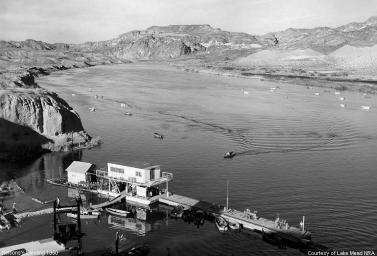
Nelson’s Landing in 1950.

Eldorado itself was eventually replaced by Nelson, a tiny community which still exists as a few houses, and which was named for Charles Nelson. He himself met a gruesome end, killed in 1897 by the renegade Indian, Avote, although Avote’s death toll was far surpassed by another Indian, Queho who we’ll come to in a future post. Five miles east of Nelson, Nelson’s Landing was established on the river, and became one of the business ports on the river during the 1920s. It was washed away in a flash flood in 1974 which swept down the canyon, taking with it nine lives as well as the wharf and buildings.

Nelson’s Landing, the devastation after the 1974 flood.

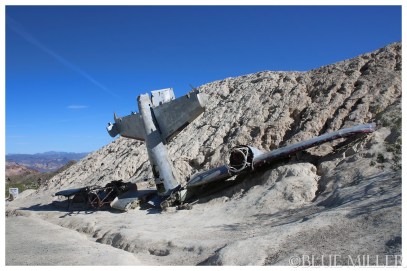
Mining ceased at the Techatticup in 1945, making it not only one of the most profitable but the longest-lived mines in Nevada. (There is indeed still gold in them thar hills, but it would now cost more than it’s worth to extract it.) The mining camp stood empty for almost half a century until it was bought by the Werly family in 1994. Since then, Tony and Bobbie Werly, with the help of their sons and family, have been resurrecting the camp, restoring to their original places a number of buildings, including some from the Wall Street Mine, and giving tours of parts of the mine. Now many visitors who head off of US-95 are armed not with pickaxes but cameras, as the Techatticup has become a popular destination not only for tourists, but for commercial photographers and filmmakers (across from the main building which houses an eclectic collection of historical, well, stuff, is a fake crashed plane from the Kevin Costner film, 3000 Miles To Graceland.)

A film prop left over from 3000 Miles From Graceland, starring Kurt Russell and Kevin Costner.

Over the years, the Werlys have added not just buildings and artifacts, but a collection of old vehicles, from an old Model T water truck to RVs and even a caravan. In the buildings is a treasure trove of signs and items but if you’re wondering why the likes of American Pickers haven’t been here, it’s because they asked and the Werlys said no. This is, they say, history, not Disneyland. The Techatticup Mine is in safe hands.

One of the mine buildings full of stuff. This will be the outboard motor section.

An original mine tank, saved by the Werly family.

No fancy food options, soda and chips are about all that’s available here.

They like trucks at the Techatticup Mine. Good, I like trucks, too.

IMG_6696

NEVER QUITE LOST ON FACEBOOK

Never Quite Lost also has a companion piece of a Facebook page now where you can find extra photos for which there wasn’t room here, featurettes (where there wasn’t enough information or I don’t know enough for a full blog post) and other stuff. And possibly otters. NQL likes otters. Please keep an eye on the Facebook page and give it a cheery ‘like’ if you would. You can find it HERE.

MOTHER PRESTON AND THE LUDLOW WAR

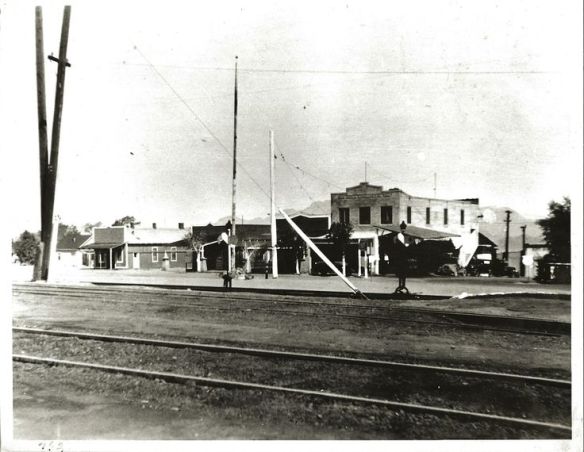
One of the earliest photographs known of the Ludlow Mercantile Company Building. At the time, there were a number of other stores and buildings beside it.

The Wild West, feuds, violence, a mysterious French woman with a temper and hot-headed Irish brothers – it’s a story which could have come straight out of Hollywood, but Hollywood was still very much in its infancy as this tale played out 175 miles away in Ludlow, California.

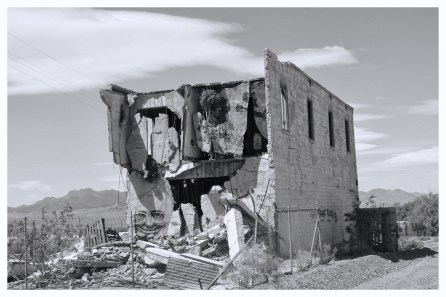
Today Ludlow is little more than a brief stop on Route 66, the largest remaining structure the Ludlow Mercantile building which was decaying long before it was damaged in an earthquake in 2006. But, almost a century ago, that very store was the centre of a feud between an Irish family and a large feisty French lady, a feud that rolled on for years.

The Ludlow Mercantile Company Building, still standing – at the moment.

Mathilde Pascaline Vigneron was born in Oise, east of Paris, in France in 1850. Very little is known of her early life except that she was married to Gustave Jacques Masquelier, despite the fact that Monsieur Masquelier was already married to someone else. He and Mathilde moved to London and then to America where Gustave became manager of the Los Angeles Steam Dyeing & Cleaning Company. However, shortly after, Mathilde had moved to a mining town where she became a ‘widow’ – despite the fact that Gustave didn’t die until 1919 (although he too had been calling himself a widower for many years previously!). In 1888, Mathilde married a Calico miner, one Thomas Jefferson ‘TJ’ Preston, and took his name.

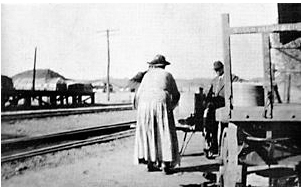
By now, Mathilde had established herself as a successful saloon owner, always willing to provide a glass of whiskey and a hand of poker, a game at which she excelled. The couple moved to Daggett and then, around 1900, on to the prosperous railroad town of Ludlow. There TJ started a delivery service but the couple’s money came from the saloon which his wife started. She had been known in the mining towns as ‘Big Mary’, an epithet which reflected both her build and her general demeanour, although I’m not sure whether people would have used that name to her face. Described in accounts of the time as ‘a physical giant’, she thought nothing of helping herself to the odd wooden tie stored by the railroad opposite her saloon, carrying one back to her place on her shoulder. The Tonopah & Tidewater Railroad never billed her for the wood; it did, however, move its ties…

The Mercantile Building showing the earthquake damage of 2006.

Within a short time, ‘Ma’ or ‘Mother’ Preston (as she had become known in the town) owned a saloon, pool room, hotel, restaurant and store. Although she was a tough businesswoman, she was also famous for her generosity in helping people, if often on a business footing. She loaned money to John Denair to build the Ludlow Mercantile Company building in 1908 but foreclosed on the store when he was unable to meet the payments, and then continued to operate it herself. For a few years, Ma Preston was very much the queen of Ludlow … and then the Murphy brothers came to town. They opened their own store, which was a bearable situation for Mathilde – until Thomas and Mike Murphy bought the building right next door to the Mercantile. From that moment, a feud began which would erupt into violence and end in court.

Mathilde resented the newcomers’ store and they, for their part, had no love for this large foreign woman. She was accustomed to bathing in a large barrel in her yard and, according to one story, one night a group of youths turned over the barrel, tipping out Ma Preston in all her glory. She blamed the Murphys and loudly harangued them outside their store, calling them every name under the sun. Mike’s Irish temper snapped and, Ma Preston alleged, he ran out and whipped her with a length of rubber hose. She didn’t wear drawers in summer and was happy to lift up her long dress and show the resulting welts to just about anyone. Then she sued for $10,000, although the resulting settlement was a fraction of that sum.

The Murphy Brothers General Store in the Mercantile Building in the 1920s.

Things went from bad to worse. In 1915, hearing that someone had jumped her claim upon a valuable mine east of Ludlow, Ma Preston rode her horse out to the claim where a tent had been erected. She later said that she had tripped on a guy rope, propelling her into the tent, whereupon a man – who just happened to be Thomas Murphy – leapt up and beat her severely with a railroad air coupler around the head and body. She immediately issued a claim for damages of $20,000, which included $10,000 for what she said was a permanently crippled right leg, stating that Murphy, who was almost half her age (she was then 66 years old), intended to kill her. The case kept the newspapers busy through the winter of 1915 but, rather disappointingly, appears to have been settled before it reached a courtroom. It would have made quite a case.

So, where was Thomas Preston while his wife was off fighting hand to hand with local rivals? Well, he might have been locked in the chicken coop behind her hotel as she was known to do when he stepped out of line. It was in TJ’s interests to toe whatever line his wife set; the money all belonged to Ma Preston; every building was in her name and she was registered as a sole trader. TJ was, it seems, kept busy running errands and chores for his wife. He was named as ‘head of household’ in the regular state census, but he was anything but.

The only known photograph of Mother Preston, clearly taken without her knowledge!

Peace seemed to descend for a few years and then, out of the blue, Mother Preston announced in 1920 that she and TJ were moving to France to see her relatives – and, more remarkably, she had sold her store, cottages and real estate for $18,000 to her hated rival, Thomas Murphy. It seems that TJ didn’t have much say in this decision – as he had his photograph taken for the very first time in his life, he said wistfully that they were only applying for passports for a year, adding “but I don’t hardly think we will stay that long … I don’t imagine how long ‘Ma’ will want to stay in France, but I imagine that she won’t care for it in a year. She will want to see the folks and look around, but then we’ll probably be coming home.”

It wasn’t to be. Ma Preston bought a small tobacconist shop which the couple ran for a handful of years before TJ died in 1926. Mathilde followed him to the grave just four months later, dying at the age of 76, of heart disease in the American Hospital in Paris. Her closest relative, a nephew, was informed by mail. She left an estate of $70,000 which was dispersed among nieces and nephews who, no doubt, had never heard of Ludlow. Ironically, her arch rival, Thomas Murphy, only survived her by less than five years, dying of cancer in Los Angeles. He had married less than a year before. His widow’s name? Matilda.

Still with the faintest of sign writing down the side.

THE GLENRIO PONTIAC

Larry Travis’s Pontiac Catalina.

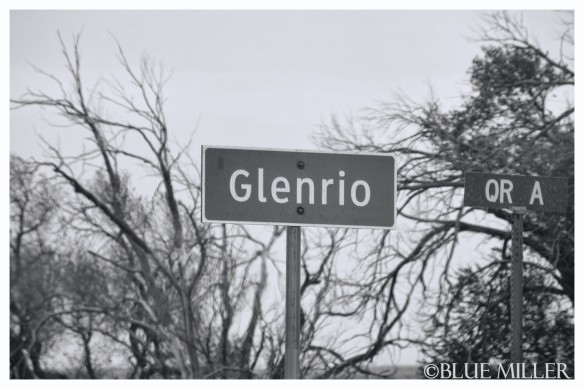
Of the many cars along Route 66, probably one of the most photographed and instantly recognizable is the white Pontiac in Glenrio, Texas. Everyone who visits the town takes a photo of it and, while they might congratulate themselves on identifying it as a 1968 Pontiac Catalina, very few will even give a second thought to how it ended up on the forecourt of a derelict gas station.  But there is a reason why the Pontiac is there.

The Texaco station forecourt on which it sits was built by Joseph (Joe) Brownlee in 1950, while the diner to the side (often and erroneously known as the Little Juarez Diner – it was never called that)  was originally called the Brownlee Diner and opened in 1952. Behind the gas station is the Joseph Brownlee house which was first built in 1930 in Amarillo and was then moved to Glenrio when Joe bought land there. It now houses Mrs Ruth Roxann Travis, Joe’s daughter and the one remaining resident of Glenrio; the dogs whose barking welcomes you to Glenrio belong to Roxann.

Roxann grew up in Glenrio, helping her father, along with her six brothers and sisters, at his two gas stations at a time when Route 66 was often nose-to-tail traffic. It all came to a grinding halt when Interstate 40 opened in 1973. Three years before, when she was just 19 and he three years older, Roxann had married Larry Lee Travis, a quiet young man from Darrouzzett. By 1975, however, everything was just about closed in Glenrio and Roxann and Larry now had a family, a little son called Michael Joe. So Larry approached a former employer, Don Morgan, and asked if he could rent the Standard Service Station on the east side of Adrian. Mr Morgan had closed the gas station a few months before and didn’t expect it to reopen. But he knew Larry was a hard worker and, after some persuasion, he agreed to rent the garage to him.

So, each day, Larry got in his white 1968 Pontiac Catalina and drove the 25 miles to Adrian to run the gas station. It wasn’t a job without risks – just the previous year a group of gas, shop and service station owners had banded together as a vigilante force to patrol the streets of Vega and Adrian. They never caught any criminals but nor were there any burglaries and robberies while they were on watch. By the beginning of 1976 the patrols had fizzled out and so there was no-one around but Larry when, after driving the Pontiac to work for the last time on the evening of 7th March, a 23-year-old Texan called Lewis Steven Powell entered the Standard Service Station. No-one knows what happened in those few minutes, whether Larry – proud of his hard work – refused to hand over his takings, but Powell made him kneel down and shot him in the back of the head before robbing the till.

The Pontiac Catalina in front of Joe Brownlee’s old Texaco gas station with, to the left, the Brownlee Diner, now often incorrectly called the Little Juarez Diner.

Powell was a high school graduate who had served four years in the Navy and never been arrested, received a speeding ticket or been suspected of any mental disorder. But Larry was the second man he had killed in 36 hours. The police were already hunting the killer of Clyde Franklin Helton near Dallas and just the next day Powell was apprehended after a shoot-out in Colorado. In a plea bargain, he pleaded guilty to avoid the death penalty and was sentenced to life in prison. Life, in this case, meant just seven years before he was eligible for parole, although there would be a 40-year sentence waiting for him in Colorado as a result of firing at police during his arrest. But again, 40 years was a vague figure. Powell has been a free man for some time, although I am pleased to say that, as of May 2017, he was back in custody due to parole violations.

Despite sitting for 40 years, the Pontiac still looks like the car Larry loved.

Larry never came home again, but his Pontiac Catalina did, and it keeps silent sentinel in Glenrio, perhaps looking after Roxann as much as her dogs and her son, grandchildren, nieces and nephews. Please remember, it’s not just another junk car parked for a Route 66 photo opportunity, respect the Private Property signs, it’s not for sale. It’s as much a part of Glenrio as Roxann Travis, and that is where it belongs.

IMG_0747

THE TOWN THAT NEVER WAS

KODAK Digital Still CameraSilverado was to be a shining new community for north-west Arizona. Situated just off US-93, outside Kingman, the 5000-acre site would have homes (around 113 luxury dwellings would stand on their own two-and-a-half acre plots), parks with barbecue grills and an 18-hole golf course designed by Forrest Richardson. Neighborhood communities were planned with 12,000 homes, schools, a fire station, shops and a sewage plant. ‘The quiet beauty of the surrounding desert’ would, said the developers, ‘enhance life’s daily experiences.’

And then, in 2008, the housing market crashed and so did the plans for Silverado. The owners applied to the Mohave County Board of Supervisors to rezone 1400 acres residential to general commercial/highway frontage to build the Albiasa solar plant. Although, despite controversy over how much groundwater this would use, the county approved the zoning in 2009, Albiasa never applied to the Arizona Corporation Commission for approval and the project was never built.

Just over three years ago, the Board of Supervisors unanimously denied allowing developers more time to meet the conditions of rezoning the property, putting the nail in the coffin for any future commercial development. You can still see the road layout on Google maps, although many of those roads are overgrown or with huge washes now bisecting them.

Today Silverado is returning to the desert. The dozen or so luxury houses that were built stand empty, some with their windows intact, some open to the elements. Many of these houses were days from completion, with their garage doors and light bulbs fitted. Some fittings have been removed but they’re surprisingly unvandalized. All that remains of the so-called dream community are these mouldering houses that never saw life and some faded boards along the highway exhorting people to buy land at Silverado Ranch.

ONLY ON A SATURDAY NIGHT

On a lonely stretch of Arizona’s Route 66, between Seligman and Kingman, where the loudest sound is the wind or a lonesome train horn or the skitter-skatter of tumbleweed across the tarmac, stands a tiny bar where once Saturday nights echoed to the sound of fiddle and guitar and boots tapping on a wooden floor.

Now the music has fallen quiet, but the sign in Valentine still remains, attracting and perplexing passers-by as to what exactly was Bert’s Country Dancing. Bert’s Country Dancing was a legend, but a small and modest legend in the way that people do things out here in a big country. Back when Bert Denton opened his little bar once a week on the side of Route 66, Valentine still had a population in three figures. In fact, in the 1970s, around 200 people lived in this tiny community. And then, of course, the interstate took the traffic away – and out here that meant it took the traffic miles away, not just a few yards away on the other side of a frontage road – but, for a while the people stayed and, on a Saturday night, they danced.

Bert Denton was born Elbert Riggs Denton on 28th February 1915 in Grants, New Mexico, the middle son of Elbert Sr and Ora Denton. The family would move to southern Arizona when all three boys, Edward, Elbert – or Bert – and Robert, were still small. Bert was 19 when his father, a cowpuncher, was bucked from a wild horse and died of a fractured skull the following day. But it didn’t deter the young man from becoming a cowboy and rancher himself and, for most of his life, he was involved in cattle ranching. While living in Gila County, Bert met Marjorie Myrtle Lan (always known as ‘Margie’). Margie had been previously married in 1930 when, at the age of 16, she wed Benjamin J Hinds who worked for the Inspiration Copper Co and lodged with her family. They had three children, Benjamin, Felix and Ruth, but the marriage didn’t work out and, by the time Benjamin was married in 1956, Bert was named in the announcement of the wedding as his father.

Mr Elbert Denton in 1987

A tough man at work, and one who served in the US Navy for over three years, Bert had a softer side, demonstrated in 1956 when the Arizona Republic published a photo of a litter of ten puppies housed at the city pound. The next day, the Denton household had one dog extra…

Both Bert and Margie were keen horsespeople and both qualified as Arizona 4-H horse show judges in the 1960s. Sadly, it wasn’t to be a long retirement, for Margie died at their home in Valentine in October 1976 at the age of just 63 years. It seems that Bert’s Country Dancing came into being shortly after this and it’s tempting to think that it was a way for the retired rancher to fill his time, as well as playing fiddle, guitar and harmonica in the band. He only ever wanted it to be a small country bar and the dancing was, dare I say it, more important than the dollar beer.

Closed, but the building is still hanging in there

But Valentine struggled in the modern day and tragedy beset the tiny settlement when post mistress Jacqueline Griggs was murdered in 1990. Two years later, the Arizona Republic newspaper carried a small piece on Valentine which, unsurprisingly, featured Bert, by then one of just 14 residents. He joked then that they were ‘dropping like flies’. Less than two years later, on New Year’s Day 1994, Bert himself died at the age of 78.

For a short time, Bert’s Country Dancing occasionally opened – for special events such as the 2002 Fun Run – but the little bar has been closed for many years now. But perhaps, sometimes, if you listen very hard you might just hear a few bars of fiddle music disappearing on the wind.

Visiting Bert’s Country Dancing at Bert’s Country Dancing Place

THE LITTLES OF HINTON JUNCTION

h2

In its prime, Hinton Junction could sell you gasoline, a meal, a night’s sleep and even a bus ticket.

These days, old Route 66 between Bridgeport and Hinton is a lonesome place. True, you know that Interstate-40 is rumbling away somewhere to the south, but here you’re on your own, your reverie on the old straight rolling concrete broken only by the glimpse of an occasional farmhouse or the moo of a curious cow.

But it wasn’t always so. Once this was a busy highway and the service station, cafe and motel belonging to the Littles of Hinton was a welcome sight for many travellers. Leon Little was born in 1911, the youngest of five children of James and Jennie Little. The Littles had something of a casual attitude to names, it seems. Leon was named Wilbur Leon, but, by the time his name was entered on the 1930 census, he had become simply Leon, while his brother went by the name of Robert or Boone, depending what form he was filling in.

h7

Leon and Ann start married life.

From the time he finished the 12th grade – and probably before – Leon worked in a service station, moving to Booker, Texas, in 1929 where he met a young lady by the name of Anna Louise Ondracek (although she was always known as Ann). When they married on 27th October 1932 in Booker, Texas, he had just turned 21 and Ann was 18. But, starting a business was important to them and, within months, they had bought an old gas station next to the swing bridge at Bridgeport on Route 66. Leon clearly realised just how vital an artery Route 66 was and, when it was realigned, he took the line that if the traffic wouldn’t come to him, then he would go to the traffic.

In 1934, a new bridge was opened over the South Canadian and Route 66 was rerouted. The Littles were already ahead of the game, building a new gas station at the west end of the bridge where Route 66 and Highway 281 met and opening it at the same time as the new alignment.

Leon (standing) oversees the construction of his new service station.

In 1940, the same year that his father died, Leon built a third station and added a cafe and a small motel. A larger house too was essential as by now the Littles had started a family. Bobby Dean was born in 1936 (puzzlingly he is referred to in the 1940 census as Baffie D), followed by Larry in 1944 and Charles the following year. For a short time they also had a young teacher, Pearl Delores Kerlick, boarding with the family before she got married, while, following ‘Jim’s’ death, Jennie Little would come to live with the family until she died in 1969.

The Littles had established that third station and motel when, in 1943, Leon received his draft papers. He was granted a 6-month deferment to get his affairs in order and so he leased the gas station, motel and cafe to GB Entz. Entz immediately shut Leon’s business down and opened his own in a new building. Ironically, by the time the six months were up, the US Government had set the upper limit of the draft at 30 years old. Leon was two years older than that and so he should have immediately picked his life and business up again. But he had made a contract with Entz and he honoured that. Instead, he spent the next couple of years working as a mechanic and tow truck driver in Texas. When the lease was up in 1945, he returned to Hinton and he and Ann began the job of rebuilding their business.

In his 50s, foreseeing the end of Route 66 and his business, Leon retrained as a US Postmaster,

This they did with determination and hard work. They also had a keen eye to providing good service for travellers. But Leon also knew that times were moving on and that the plans for the new interstate would make his business impossible to sustain. A year before I-40 bypassed Hinton, Leon had already made plans for his next career, training as a postmaster. He began work at the Hinton post office while Ann continued to run the business and then, in 1962, the interstate opened and Route 66 stopped. The Littles had opened their main business on the day that Route 66 took on its new alignment across the new bridge in 1934 and, with fitting symmetry, they closed it 26 years later on the very day that the interstate opened.

h5

This centre section is all that remains today of the gas station and cafe. There would have been a clock in the hole in the centre roofline, while the EAT sign was lost many years ago. The propane tanker hasn’t moved in at least 35 years.

However, hard work over those years had meant that Leon and Ann could put their boys through college as well as buy a house in Hinton. Until he retired, Leon worked at the post office and Ann worked as a receptionist for the Hinton Clinic. With sons and, later, grandchildren, Leon was involved in the local community, coaching Little League baseball and becoming a 32nd degree Mason. He died on 3rd February 1994 and Ann passed away at the end of 2006. They are both buried in the town they loved and served for so long.

Oh, and Leon clearly hated his given name all his life. Even on his gravestone in Hinton Cemetery he is listed only as W. LEON LITTLE!

h6

The gas station is falling down these days, but you can still see the old shelving and how it was back in the day.

THE FACTORY THAT NEVER WAS


11334051_885679401499895_8475226351948295664_o

Just south of Beatty,  Nevada, is the Elizalde Cement Factory which was built by the Carrara Portland Cement Company at the beginning of the 1940s.

11337060_885679411499894_6439798320751203696_oAt the time, it was supposed to be one of the most advanced plants of its kind in the USA with houses for the workers. It would produce commercial grey cement and also a fancy high quality cement made from the crushed marble and clay from the nearby Carrara quarry.

However, the factory never went into operation. The popular notion is that it provided to be too costly and logistically difficult to move the cement. 11289489_885679418166560_1426846276698904044_o

Whether that’s true or not, just a month before production was due to start in July 1941, a fire completely destroyed the machine shop, storehouse, blacksmith shop and an office. A few weeks later, the Carrara Portland Cement Company at Carrara closed down, apparently unable to find parts to replace those lost in the fire. 10988513_885679408166561_8010437174527010206_oThe company, however, announced its intention to continue, and then Pearl Harbor happened. Fuel rationing the following spring made it impossible for the company to transport its goods, even if it had been able to get the plant back up and running. It was abandoned, although some of the machine11139355_885679398166562_463181637644374783_nry remained for several years.

LAST TOLL OF THE BELL’S MOTEL

AZ079070

In its heyday, the Bell’s Motel (named after its original owners – but also called the Bells and the Bell) on Route 66 in Kingman, Arizona, was a ‘fully modern, fire-proof, air-cooled motel’. Built in 1945, it had 13 rooms and boasted that it had rooms with both cooling and heat, tiled baths, tubs and showers, ‘Beauty Rest mattresses’, television and a playground and patio. Later, as it fell on harder times, it became the Desert Lodge Apartments.

06_10_012928In 2012, a state-wide survey for the Arizona State Historic Preservation Office recommended that the by now boarded up Desert Lodge Apartments should be put forward for entry onto the National Register of Historic Places with ‘High Priority’, this rating means it filled one or more of the following criteria: an excellent example of its property type and strong Route 66 character; particularly rare property due to age, type of construction or architectural style; good intact properties which appear endangered due to deterioration or redevelopment and/or being sited in a high priority historic district. Even in its sad state, with its ‘giraffe’ stone façade, the motel ticked at least two of those boxes.

AZ079280 In April 2015, the Californian owners announced they would be gutting the property, leaving the stonework standing and it would then be redeveloped as living accommodation. The interiors were indeed gutted and all the woodwork ripped out, and then nothing else happened. For a year, the Desert Lodge Apartments have stood, denuded and fenced off, and I’ve hoped against hope that the planned renovation would take place.

Yesterday bidding closed for the complete demolition of the Desert Lodge Apartments and the clearance of the site.


UPDATE Spring 2017: And so the demolition crew moved in. It took hours for there to be nothing left of the Bell. Now there’s one more empty lot in Kingman.

desert