
Fine food and cocktails – this was the place to go in Kingman in the 1960s.
Kingman’s Chinese community has been part of the town for as long as it has existed. But perhaps one man more than other was influential in the growth of this Arizona town.

‘China Jack’ Lum with, on the right, Charlie, and on the left, Wong, in around 1920. Photo (c) The Lum Family
Charlie Hing Lum was born in Canton in 1912 and, at the age of ten, emigrated to the United States with his father Lum Sing Yow – known as Jack – and brother Wong Lum. They settled in Kingman where his grandfather had moved in 1884 and Jack subsequently bought the Boston Cafe on what would become Route 66 and now Andy Devine Avenue. This was a time when every restaurant in town, with the exception of the Beale Hotel and the Harvey House, were owned and run by the Chinese. Charlie left school after the eighth grade to work as a dishwasher at his father’s cafe as well as working another job at the Mohave Cafe near the Beale Hotel. It was at the Mohave Cafe on October 20th 1926 a 14-year-old Charlie would see his boss, Tom King, killed by members of the San Francisco Bing Kong Tong.
In 1931, Charlie returned to China to look after his sick mother and, while there, he married his first wife, Jan Gum Foon and their daughter, Mary, was born. Although he loved Kingman and knew virtually everyone who lived there, Charlie was upset when his father decided to hand the café over to his brother, feeling his father had no faith in his abilities. So, when his wife died in 1938, he returned to America but opened his first restaurant in Williams; however, the Great Depression was in full swing and it failed.

1961 and the Jade is a blaze of neon.
Charlie moved to San Francisco and worked in the shipyards before starting a restaurant and bar called the Shanghai Lil Club. He also married again to Jeane Jang, the sister of his late wife but, while he proved to be a natural in the restaurant business, the big city also had the lure of alcohol and gambling. Jeane, along with his uncle, persuaded him that, with busy Route 66 running through it, it would be a good time to return to Kingman. In 1951, Charlie sold the Shanghai Lil and decided to open a Chinese restaurant in Kingman (where his brother was successful running the Boston, now renamed the White House Cafe). No-one else in town – or for that matter in north west Arizona – was serving Chinese food, but Charlie was certain he could make a success of the venture.
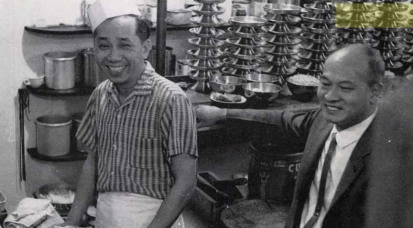
Charlie Lum tells his chef, Hubert Woo, how to cook the Jade’s famous Cantonese cuisine!
And he did just that. The Jade Restaurant on Route 66, just west of the Arcadia Lodge, was a huge success and, in the small community of Kingman, Charlie really found his home. He would go on to become the first Chinese member of the Kingman Elks Lodge, of the Rotary Club and an honorary member of the Lions. He sponsored local softball and baseball teams, worked with the Chamber of Commerce and sponsored radio broadcasts. Every year before school began, and again at Christmas, Charlie rented out the movie theatre and threw a movie party for all the kids in town.

One of Charlie’s final ventures – he always loved running a bar and lounge.
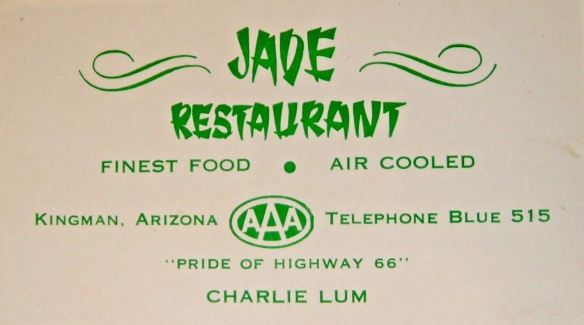
Everyone ate at the Jade – couples, families, business colleagues, ladies lunch clubs. It was, as Charlie claimed on his business cards and match boxes, ‘The Pride of Highway 66’. But Charlie didn’t content himself with the restaurant. In 1964 he built Kingman’s first coin-operated laundromat and a ten-unit apartment building called Lum’s Apartments. He was so taken by these new ventures that, in 1965, he sold the Jade to Tommy Choy who gave it something of a makeover, with flaming torches outside and the Bora-Bora room where American, Chinese and Polynesian food was served while Jess Parker tinkled on the organ.

Charlie stands in front of his KFC store on Route 66. Photo (c) The Lum Family.
Charlie, meanwhile, capitalised once more on Route 66 when he opened a Kentucky Fried Chicken franchise. He made it a popular stop for tour buses on their way to and from the Grand Canyon by providing bus drivers with a free meal. In 1977, he received the Franchise Service Award from KFC head office for ten years of quality service. But fried chicken and soap suds weren’t enough for the indefatigable Mr Lum. In 1973, he built Lum’s Cocktail Lounge which offered cocktails, dancing and pool tables, as well as a package goods section for off-sales.
He finally retired in 1978 and moved to Hawaii with his third wife (Jeane died in 1957 and Charlie remarried in 1961 to May Yin Chow), although he often returned to Kingman. Mary, his only daughter had spent her first few years in China but was finally able to join her father after the war. For many years, she and her husband also ran a Chinese restaurant in Kingman, the House of Chan.

The interior of the Jade Restaurant today.
When he left for Hawaii, Charlie’s Rotarian friends wrote him a warm and affectionate farewell, part of which read; ‘He has stood in the fore of civic affairs here, always willing to give of his time and money, never failing to lend a helping hand when it was needed … It will be a long, long time before a character of such proportions walks the stage of Kingman life again. He is one of the most profoundly happy, sincere and caring people we’ve ever know.’ Charlie kept his links up with Kingman until his death in 1996; in 1983 he donated $6500 for a flagpole at the Veterans Centennial Recreation Complex and attended the dedication.

The Jade Restaurant as it is today.
The Jade Restaurant now stands empty, a nondescript building on Route 66 that’s overlooked by most who pass and which has been up for sale for several years. But once this was the place to be in Kingman; Charlie Lum and his restaurant really were the pride of 66.



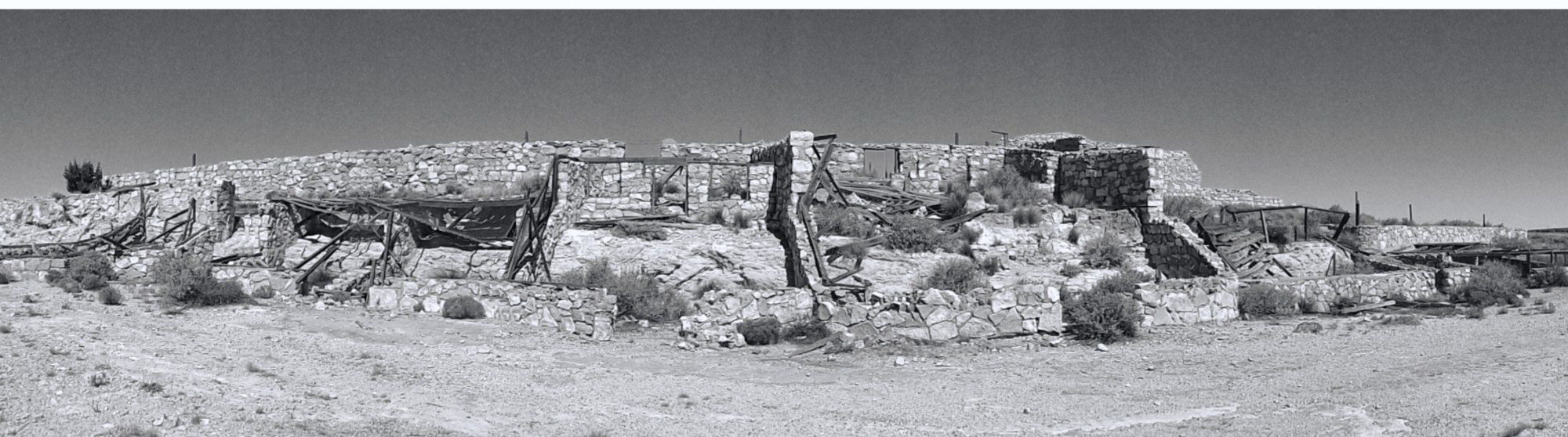
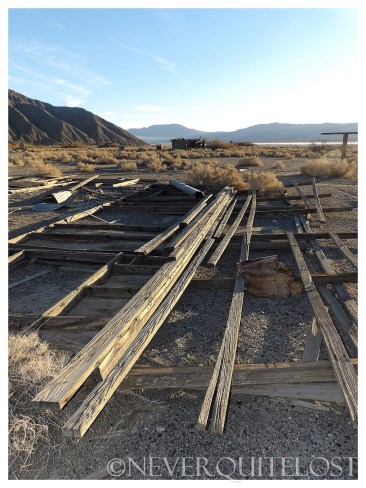
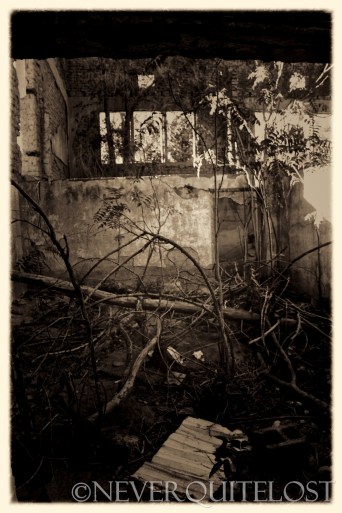 There is a rumour that the blaze was the result of an experiment in a chemistry class, but that’s clearly untrue for two reasons. Firstly, the school was closed due to failing attendances (along with another two local schools in the same year, 1956) not because it burned down, so it clearly didn’t happen while the school was open, and secondly, such a conflagration at a working school would surely have made the local newspapers – which reported just about everything back then. Yet there is nothing in any of those newspapers.


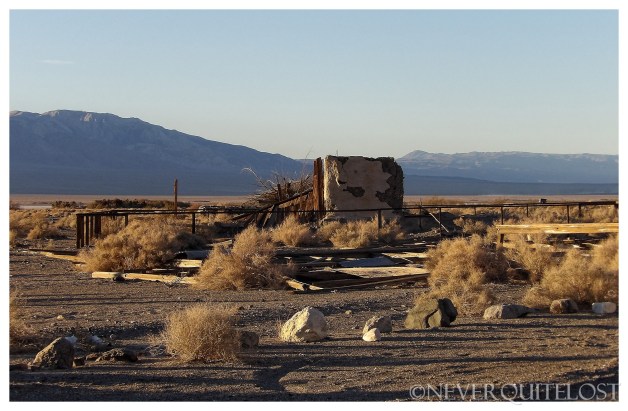
 For its first few years, Ballarat thrived. Some 500 people made their homes in this desolate part of California and the town had seven saloons, a post office, school, jail, morgue, three hotels and a Wells Fargo station. But, apparently, no church.
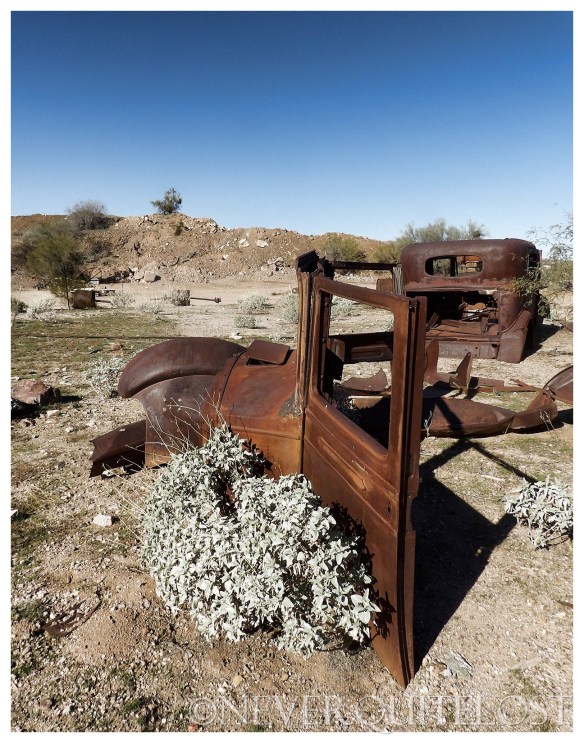
  In the 1960s, Charles Manson and his followers moved into the Barker Ranch south of Ballarat, travelling through what was left of the town to get there. In October 1969, he and others were arrested at the Barker Ranch, Ballarat being the last place Manson was a free man. Today Ballarat has a small store run by Rocky Novak with irregular opening hours, the remaining building are mostly in ruins (a plan in the 1960s to make an RV park here failed miserably and finally petered out in the 1990s) and the only reminder of the Manson Family connection is an old Dodge Power Wagon.
  So, where did the Power Wagon now in Ballarat come from? One theory is that it belonged to Bobby Beausoleil and had been left at the ranch. When the arrests and trials were over, Kirk Barker, owner of the Barker Ranch, moved that Dodge down to Ballarat as a runaround. But no-one seems to know for sure.


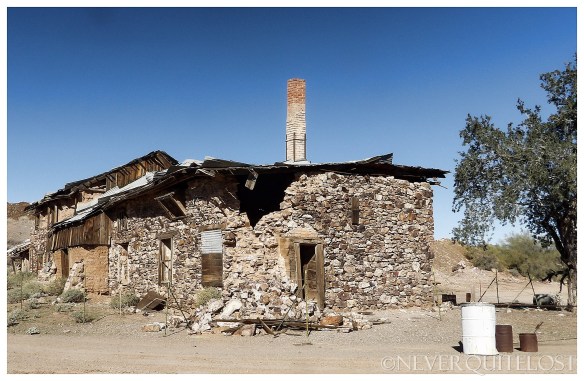
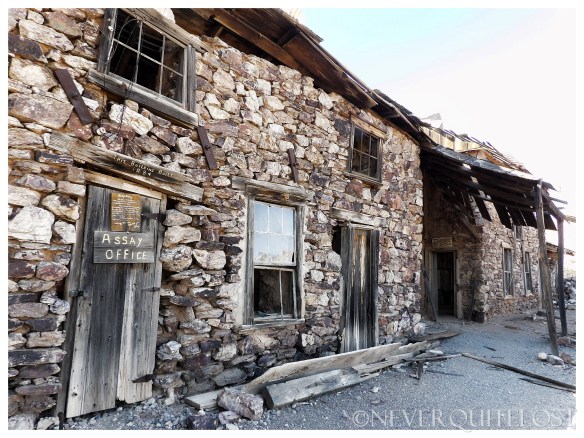
 Over the years, the Vulture Mine produced $200 million of gold, although it’s likely almost as much simply disappeared into various pockets. The assay office was particularly prone to being burgled and thousands of dollars of gold was stolen over the years. 18 men are supposed to have been hung from the Ironwood tree which still stands (next to Henry Wickenburg’s cabins), all of them guilty of stealing gold or ore, although there’s no record of any such hangings actually taking place. It’s a good story though.









 NEVER QUITE LOST