
Sometimes I still wake up in the night terrified of this old-timer. It’s not natural to have glowing eyes, even in Oklahoma.
There are Good Things and Bad Things about travelling on your own. The Good Things include eating rubbish for days on end and being able to drive 50 miles off route because you spotted a sign saying ‘World’s Biggest Ball of String’ without having to have a lengthy discussion with your co-pilot as to whether you have time, whether you need to see the World’s Biggest Ball of String (for me that goes without saying, although I am constantly surprised when I find myself to be in a minority of one on this matter) and if it will actually be the World’s Biggest (unlikely, but do you want to take the chance on that?).

Although knitted hair may never make a comeback, this chap will be delighted to know that his big painted on eyebrows are all the vogue with young ladies.
The Bad Things include eating rubbish for days on end and going a little bit strange. Talking to yourself is acceptable; having full-blown conversations in two different voices perhaps not so. I know I’ve been out there on my own too long when I get fits of giggles about things. And so it was at the National Route 66 & Transportation Museum in Elk City, Oklahoma.
Now, before I go any further, I cannot recommend the museum highly enough; not only does it have an excellent museum devoted to Route 66, complete with copious paraphernalia and classic vehicles (including a recreation of the Joads’ truck), but the extremely reasonable price of your entry ticket also allows you to roam around the Farm & Ranch Museum, the Blacksmith’s Shop Museum and the Old Town Museum.
It was in the latter that things started to go a little awry. Like the rest of the place, the Old Town Museum is an excellent and loving recreation of times past, with shops, houses and a school. To add verisimilitude, the creators had installed mannequins.

Why a trilby rather than a Stetson? My theory is the creators used all their hair up on his luxurious moustaches and sideburns and had nothing left for his head.
Just like the people they were intended to represent, these were a mixed crew; there were a few who had clearly started their careers in the windows of department stores, the passing of the years marked by the changing of their wigs, while others were more ambitious and may even have been salvaged from an out of business waxworks museum. They were all, well, slightly odd and while if I had had someone to point this out to, the matter might have dropped there. But I didn’t. All I had was a rising hysteria that increased with each new tableau. Fortunately it was early and the museum wasn’t yet busy, but people did begin to look. That didn’t make matters any better. There were other photos, but by now I was giggling so much everything was destined to be out of focus, including myself.

Half surfer dude, half baker.
Please do visit the National Route 66 & Transportation Museum and don’t just stop and take a photo of the big 66 shield and Myrtle, the Giant Kahina, and pass on, because the whole place is really quite wonderful. Even the mannequins which, in their oddness and homemade quality, somehow capture the essence of roadside Route 66. Just behave with a bit more decorum than I did.

As if it wasn’t enough to make him wear a hat several sizes too small, what indignities have been committed on this poor man’s ears?
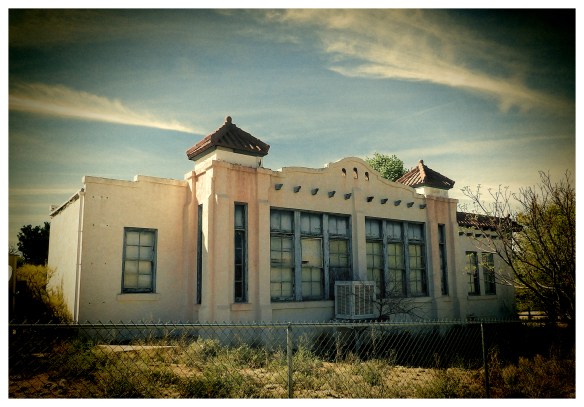


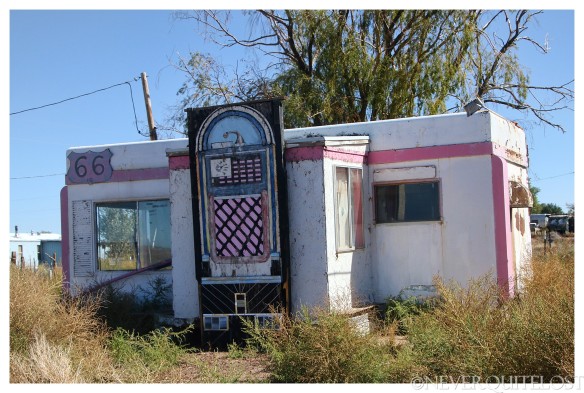 Perhaps the biggest surprise to me about the Route 66 Valentine diner in Sanders, Arizona, is that it does actually look like a Valentine diner. Shabby and sliding rapidly into decay like so many of its peers, but still clearly of its type.
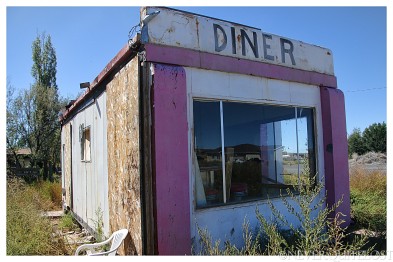 Why a surprise? Well, because, as far as I knew, the Route 66 Diner in Apache County’s Sanders had taken a Valentine diner and gradually eaten it, subsuming the original building into three containers and increasing the space so the original eight stools were replaced by seating for 60 customers. But, by the time I visited a few months ago, all those extra extensions had disappeared and the diner stood by itself, fading under the Arizona sun and having closed its doors on its final customer a few years before.
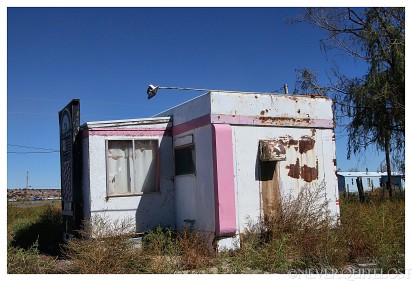 This particular Valentine prefabricated diner (it was clearly not purchased outright by its first owner as it still has the safe in which the owner would deposit a portion of his weekly takings to be collected by a Valentine agent) was first situated in Holbrook. It was then bought and moved to St John’s although, due to problems with zoning, it was never opened.
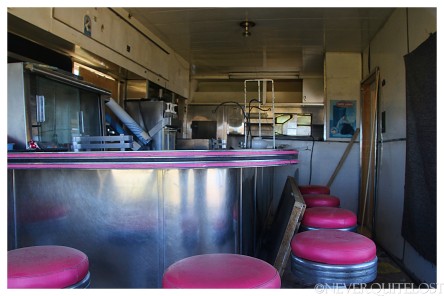 However, it was while the little diner was in St John’s that it was spotted by one Ena Middleton. Ena has true Route 66 heritage: she not only grew up on the Mother Road but is the grand-daughter of the infamous Henry Miller of Two Guns. She says that, peering through the windows, she fell in love with the napkin holders. She bought the diner with her husband, Frank, and then moved it to Sanders. It was then moved once more, still within Sanders, where it was so busy that it had to be extended – the aforementioned containers – although 99% of its trade was local and not Route 66 travellers.
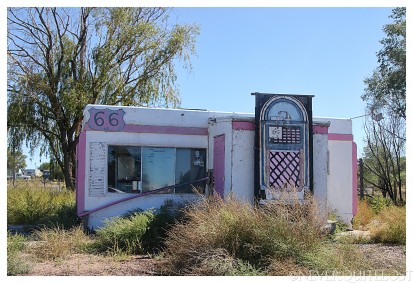 While still open, the Route 66 Diner had been up for sale, Ena and Frank wanting to retire to their land, partly due to ill-health. It seems that there have been no takers, other than for the container extensions to the little Valentine diner.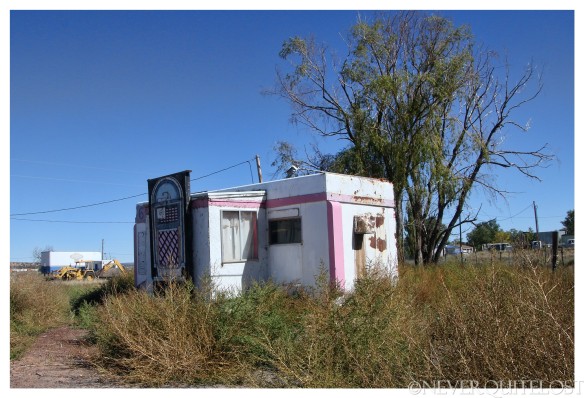




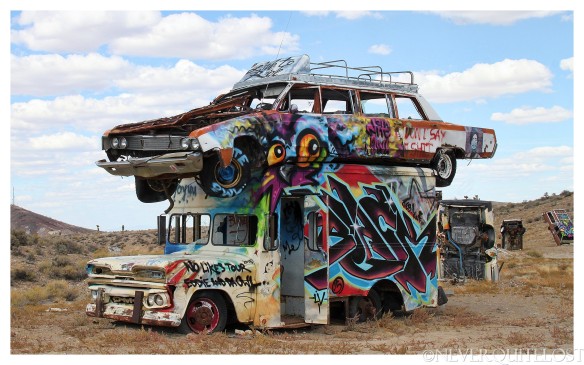
 But on the southern edge of town is a place that’s part art installation, part modern graveyard. The International Car Forest was the work of Chad Sorg and Mark Rippie. Rippie owned the 80 acres of land next to Highway 95 and enlisted Sorg (who fell in love with Goldfield and would move there in 2004) in an ambitious project to set the world record for the most upturned cars in an art work, primarily to beat Carhenge in Alliance, Nebraska. Rippie also owned over 40 cars, trucks and buses. Trust me, this is not particularly unusual in Goldfield.
 Work began in 2002 and continued over the next decade, using a back hoe and a lot of hard work to ‘plant’ the vehicles. Some were posed nose into the ground, some balanced on the top of others, some poised over mounds of earth. The idea was that the site would be a blank canvas for artists and would inspire graffiti, rather as the better-known Cadillac Ranch ending up doing.
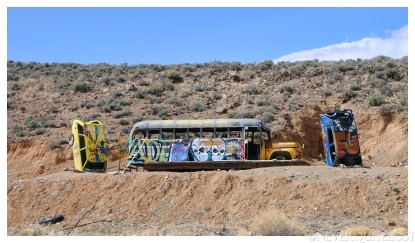 But, unlike that Texas landmark, the International Car Forest seems, for the most part, to have attracted people with some artistic flair. Most of the cars and buses have been painted with designs rather than having names scrawled badly in spray paint. It’s probably the fact that the International Car Forest is in the middle of nowhere – and once you get to nowhere you have to traverse some pretty potholed roads – that has protected it from becoming a eyesore like Cadillac Ranch.
 Unsurprisingly, considering that they were two diametrically opposed personalities, Chad Sorg and Mark Rippie’s partnership did not end well. Sorg is an artist who had a vision for the International Car Forest; Rippie just wanted his name on a Guinness World Record. They fell out irrevocably not long before Rippie went to prison for two years for improperly possessing and attempting to purchase firearms. He had been found not guilty of a 1970 armed robbery in Colorado by reason of insanity, something he neglected to tell a dealer in 2010 when purchasing a gun. In 2013 he was arrested at his home in Goldfield where police found with 15 firearms, including two loaded semi-automatic assault-type rifles with extended 30-round clips and a loaded semi-automatic .40 caliber pistol and over 22,000 rounds of ammunition. The court was told Rippie was well-known to law enforcement and others in the Goldfield and Tonopah areas.
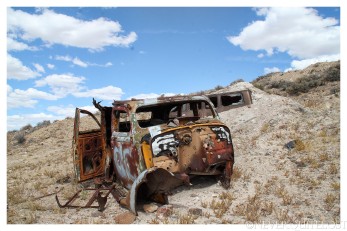 Chad Sorg is still an artist and blogger. He has never been found insane. Mark Rippie is out of jail and living in Goldfield where he describes himself as ‘a fat old man with a shit load of guns and ammos’. And quite a few cars that don’t work…

 Last year I was covering the Las Vegas Bike Fest for my magazine when I decided I needed a break from the bling. It was also that I wanted to find essential supplies (water, cigarettes, chocolate – the basic food groups) at a reasonable price and I had spotted a small convenience store outside the show. The trouble was there was a security guard and a large fence between me and said shop.