
Tulsa old and new: looking from the middle of the 11th Street Bridge towards the city centre
While I may be never quite lost, sometimes I find myself in places where I possibly shouldn’t be. But rarely in plain sight in the middle of a city.
Tulsa, Oklahoma, was built on oil, but it was also the hometown of Cyrus Avery, ‘the Father of Route 66’, and he would probably never have been welcomed home again if he hadn’t ensured that new highway ran through Tulsa. However, there are a couple of equally likely and valid reasons; Tulsa had a bridge.

The bridge in 1917, shortly after opening
Moreover, it was the first purpose-built automobile bridge to span the 1450 miles of the Arkansas River which runs through the city. Built in 1916, it was something of a wonder for the flatlands. One of the longest concrete structures in the Midwest, it was also the first major multi-span (eighteen of them) concrete bridge in Oklahoma. By providing an easy crossing of the Arkansas, it allowed the oil industry in Tulsa to flourish.
And the second reason? Remember that Cyrus Avery came from Tulsa; serving as Oklahoma County Commissioner from 1913 to 1916, he was involved with the construction of the bridge and it must have had a place in his heart. Even today, it’s still a structure of which to be proud.
It was built by the Missouri Valley Bridge and Iron Company for $180,000, and, at 1470 feet long and 34 feet wide, supported a railroad track in the middle and a single lane of vehicular traffic either side, flanked by pavements. In 1934, it was widened to 52 feet and 8 inches and could accommodate four lanes of traffic. Careful traffic, that is. 52 feet is not all that wide…

There was a gate open – honest!
And, for the next 63 years, the 11th Street Bridge served Tulsa well, bringing prosperity into the city, and allowing travellers to make their way across Oklahoma to the promised lands via Route 66. But it started to show its age. Lanes were closed, load limits implemented and then, in 1975, the City had to pay compensation to a woman who fell through a hole in one of the walkways. It was only $1100, but it was a wake-up call that the bridge was in trouble. A new crossing was commissioned and, in 1980, the 11th Street Bridge was closed to traffic. There was talk of tearing it down, but, luckily, the money to demolish it never seemed to quite transpire.

Too dangerous for city employees to step onto the bridge to spray them, the weeds are taking over
In 2004, the bridge was renamed the Cyrus Avery Route 66 Memorial Bridge, but a new fancy name didn’t make it any more structurally sound. Then, in 2008, it was closed to even pedestrians, a plan to make it safe enough to reopen to walking traffic having been costed at $15 million. Rather than spend that sort of money, the city gave the bridge a bit of a spruce up and then gated it off. This was after surveyors decided that the bridge was too unsafe to even walk on. I suspect they probably don’t even want you to look at it that hard. The blacktop on the bridge is actually just a waterproof coating and the bridge is too weak to hold up another layer of asphalt. The city sprays the weeds occasionally, but even that is considered risky.

Looking down the Cyrus Avery Memorial Bridge from the Cyrus Avery Centennial Plaza. Tulsa is proud of its native son
Now, I have to say I didn’t know all this when I found myself at the 11th Street Bridge one grey October morning. I don’t know why a side gate was open, but even if I had realised that there was a distinct possibility a hole might open up underneath me and plunge me into the muddy waters of the Arkansas River, then I would probably still have walked its length. Only afterwards did I realise how lucky I was to have had that chance.


 Clyde was two years old himself when his parents, Victor and Lydia, moved to Palmetto from Santa Rosa, California, no doubt hopeful of making that big strike and never dreaming they would lose both their sons so tragically. The marker only mentions Clyde, and people have often assumed that Kenneth was buried with him. However the little boy lies alone, his younger brother having died and been buried in Silver Peak, another town to the north west. The Blair News reported that Mrs Hart had ‘been quite ill for several days prior to starting for California, her illness being aggravated by the mental anguish of the loss of the children in so short a time.’
 After burying their children, the Harts continued back to California; Lydia gave birth to a son, Alan, almost exactly a year to the day after Clyde’s death, and a daughter, Evelyn, in 1910. Both Lydia and Victor lived into old age, Victor dying in 1958 at the age of 80 and Lydia living until she was 97 and they are buried beside each other in the Oddfellows Cemetery in Sacramento. Having lost two children so young, it must have been a consolation that their son and daughter lived long and full lives. Alan died in 1994 and Evelyn just nine years ago aged 96. Did the family ever come back to Palmetto to visit the grave or was it too painful a part of their life?
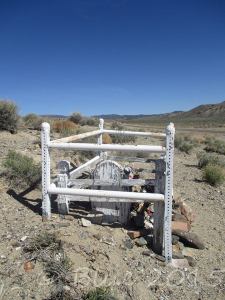 I thought at first how odd it was that there are no other graves in the area, but because Palmetto existed for such a short time – the silver that was struck lasted barely a year – it could be that the little Hart boys were the only people to die out in this lonely place. But the toys and paraphernalia on the grave (I left a toy car) show that they are not forgotten.
 By 1861, it had a population of around 1200, with accompanying saloons, hotels and boarding houses, as well as stabling for those travelling between the Comstock Lode mines of Virginia City and processing mills. Devils Gate,
 Silver City managed to thrive until the completion of the Virginia & Truckee Railroad in 1869 after which the population quickly moved away. Now about 100 or so people live there, most of whom probably knew I was there. It is a little bit The Hills Have Eyes. Apparently, the cemetery is worth a visit, but it appeared to be on the other side of the road closure.




 NEVER QUITE LOST