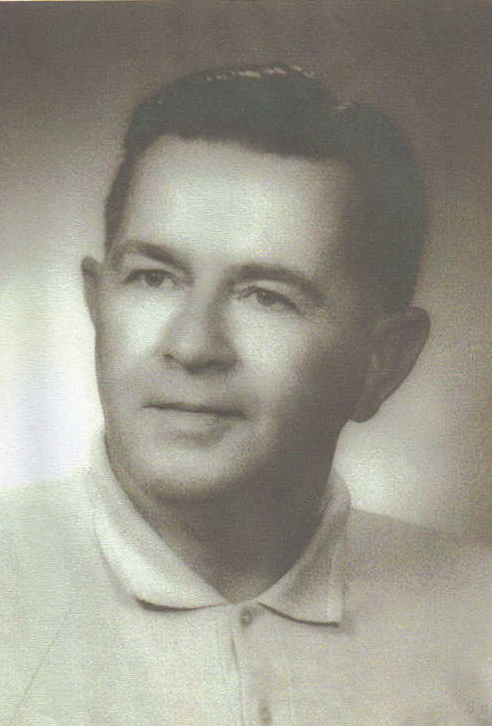
John D Hearon, a remarkable man.
The snow started falling over the Texas Panhandle on 1st February 1956. Within hours it would herald one of the worst blizzards in American history as snow fell for four straight days over Texas, Oklahoma and New Mexico; by the time it began to thaw, at least eighteen people and hundreds of cattle were dead. The little town of Vega bore the brunt of the storm, recording a staggering 61 inches of snow, but everywhere was affected. But life had to, somehow, go on and that meant Route 66 had to keep rolling.
If the road was open for business, then so were the companies that used it, among them the bus line, Continental Trailways. At 5.30am, John D Hearon, 38, pulled his Vista-Liner out of Amarillo, heading to Tucumcari. He knew that the conditions were dire, having already done a run in the opposite direction, arriving in Amarillo two hours behind schedule. There are varying estimates as to how passengers he had on board for that return trip – contemporary accounts state between 14 and 35 (although the lower figure is probably the correct one) but all agree that among the passengers was 21-month-old Patricia Henderson, travelling with her mother, Ruth.
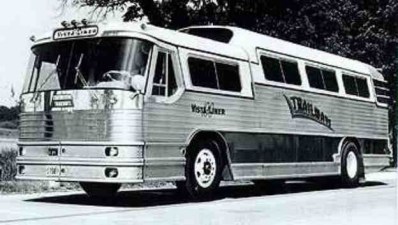
Ohio company Flxible built just 208 Vista-Liners between 1954 and 1958. Continental Trailways purchased 126 of them and it was one of these buses John Hearon was driving on the Amarillo-Tucumcari run.
All was well until around 9am when, John Hearon related; “I was going about 25 miles an hour when I hit this drift in a deep cut. Snow was about waist high and we couldn’t move the bus. No-one got excited, though. We had about a half tank of fuel, so there was no immediate worry about heat. We figured we’d just sit tight until help arrived.” But more than five hours passed with not a single vehicle in sight – the blizzard had closed down Route 66 and even snow clearing machinery couldn’t get through – and Mr Hearon started to worry that the bus was running low on fuel. Once that ran out, the bus would become a freezing metal box – and possibly a tomb. The only food on the bus was two sandwiches which the passengers gave to the little girl. Mr Hearon decided that he had to go for help. Norris Turner, a passenger from Houston, offered to go with him, but Mr Hearon urged him to stay behind and help keep up the morale of the other passengers. John Hearon opened the door and set off into the storm.
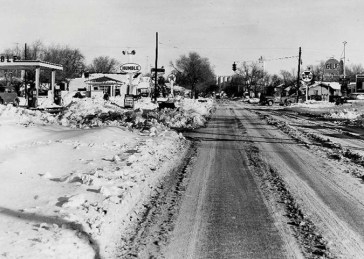
Plainview, to the south of Amarillo, at the end of the five-day storm.
Adrian was the closest town, but John Hearon realised that he would be walking uphill and into the freezing wind and blowing snow, so he headed west for Glenrio. He was wearing only his bus driver’s uniform of low cut shoes, unlined gloves, woollen trousers and a light regulation jacket and within minutes he had to return to the bus to find a piece of cloth to wind around his head to protect his ears and neck. Then he set off again, finding his way by the telephone poles along the now hidden road, often slipping and falling. He came across a couple stranded in their car who tried to persuade him to seek refuge with them, but Mr Hearon was adamant his passengers, especially the little girl, needed help and he pushed on.

The Brownlee Diner rallied around to feed the stranded bus passengers.
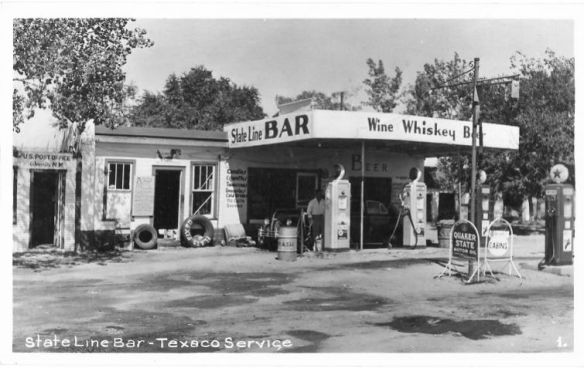
He would later tell John Phillips of the Reader’s Digest, “About nine o’clock my eyes felt strange. There was a beacon north of Glenrio I’d been using as a guide, but suddenly I stopped seeing it … my right eye had gone blind.” Not long after, his left eye began to cloud up as he began to succumb to snow blindness. Slapping his face to keep himself awake, he finally saw distant spots of light just after 10pm; he had been pushing himself forward for hours with thoughts of steaming hot coffee and he passed Joseph Brownlee’s gas station, stumbling towards the diner next door. But his strength finally failed him and he fell to his knees in the snow. He managed to whistle a couple of times and this saved his life. A young man in the diner heard him and found him in the dark, dragging him into the gas station. Joe Brownlee said; “He looked nearly dead. His face was blue, his eyes closed, his lips swollen. I’ve never seen anyone look like that.”

The Brownlee gas station where John Heardon was taken when he reached Glenrio.
John Hearon had staggered through the storm for almost nine hours. Frostbitten and snowblind, he could barely speak, but he managed to tell his rescuers exactly where the bus was, how many passengers were on it, how long they had been without food and how much gas had been in the tank when he left. Joe Brownlee loaded up his Power Wagon with food and blankets and, putting chains on the wheels, fought his way to the bus, arriving at 2am. Thanks to John Hearon’s incredible bravery, everyone was well and in good spirits and the engine was still running, although they were no doubt pleased to see Joe Brownlee. Over several trips, all the passengers were ferried back to the diner where the town donated food for all of them.
Mr Hearon spent just four days in hospital. After six more days at home, he resumed his Tucumcari-Amarillo route. His courage was recognised with an all-expenses paid holiday to Treasure Island in Florida (Continental Trailways let him have the extra week off, which was mighty big of it) where he was feted and presented with an engraved medallion and his wife, Winnie, with an orchid and a pendant. Other gifts were a little odder; as well as money, the town of Sudan, Texas, presented him with a bale of cotton.
However, there was no long happy ending for John Hearon. On 12th March 1965 he passed away from pneumonia while suffering from lung cancer. He was just 47 years old. But to his four children, the oldest of whom was just 12 when he died, to the passengers of that bus and to the people of Glenrio he was and always will be a hero.
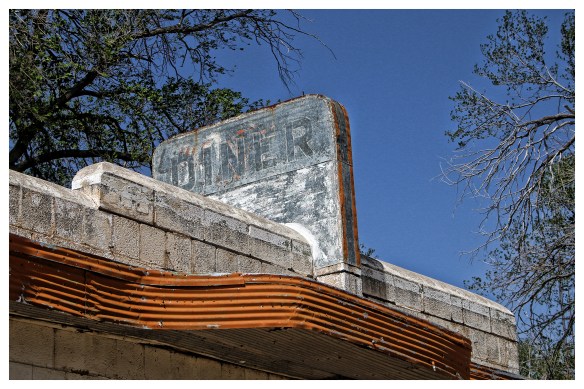
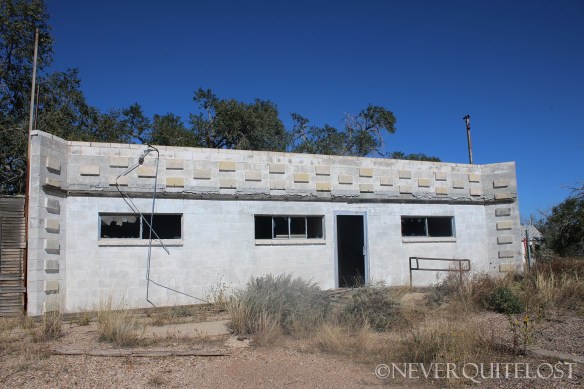
The diner (the place was built to resemble a Valentine Diner) and the idea of steaming hot coffee kept John Hearon going during his courageous trek.



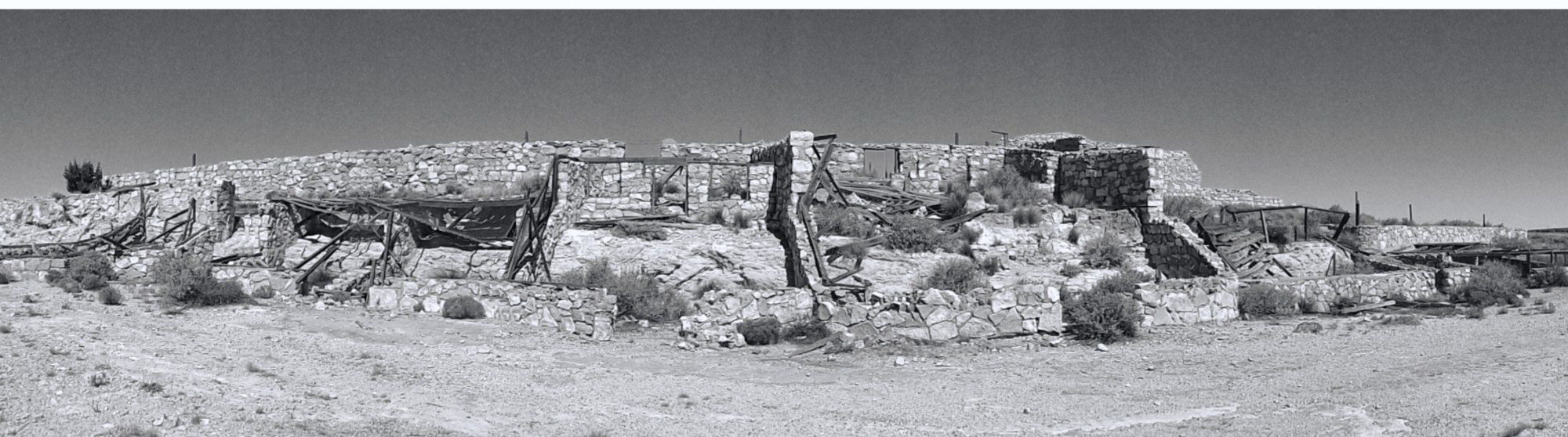
 It was the work of Seattle advertising man, Boyce Luther Gulley, who, in 1929, was diagnosed with tuberculosis. The best hope of a cure then relied upon being in a warm, dry climate, so he moved to Arizona. The only problem was, he didn’t tell his wife, Frances, or his 5-year-old daughter, Mary Lou, where he was going. He simply said he wanted to pursue a life as an artist and drove off in his new Stutz Bearcat. They would never see him again.
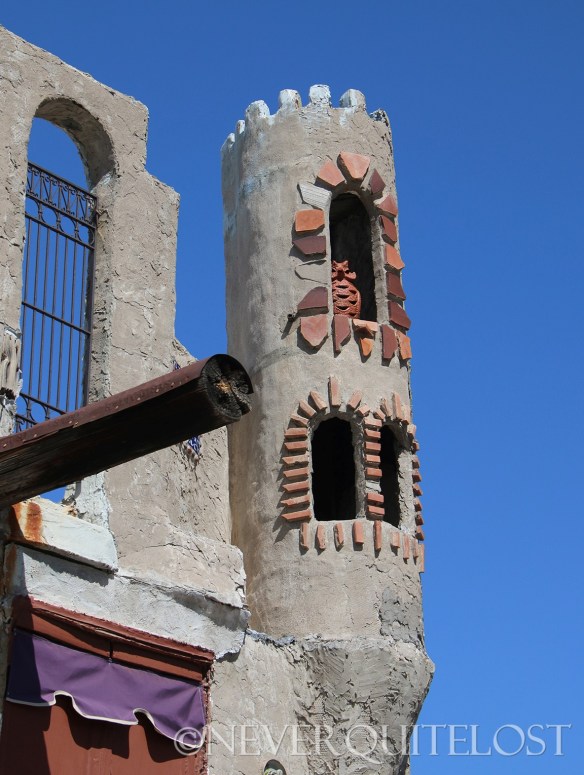
 It’s thought that Gulley did indeed believe that he had just six months to live and didn’t want to put his family though any suffering (although simply deserting them doesn’t seem to be much of an alternative). Six months passed and then another and he hadn’t died. So it was then that he started upon his life’s work; staking a claim on land close to the South Mountains, he began building what would become an incredible, meandering house with 18 rooms, 13 fireplaces, a chapel and a dungeon. It was built of all types of recycled material – adobe, stone, railroad tracks, telegraph poles, even parts of the Stutz Bearcat when it ceased to be of use – held together with cement, mortar, calcum and goat milk. Gulley, who had had basic architectural training, bartered for materials and also laboured and sold shoes when he needed cash.
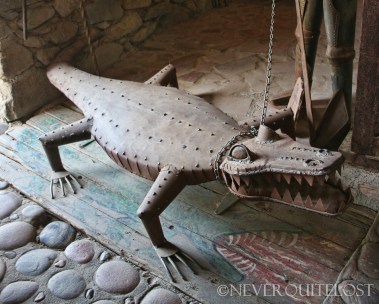 And for the next 16 years the house grew and grew. However, even with his tuberculosis cured, at no point did Gulley send for his family. Some stories say they believed he was dead, but it seems likely that he did send the occasional letter to Seattle in later years, although without saying exactly where he was (other family members, however, did visit the house, as did many of Gulley’s friends). Then, in 1945, Boyce Gulley died, not of TB but cancer. He left the house to his wife and daughter, along with a mysterious locked trap door and the stipulation that they had to live there for three years before it could be opened.
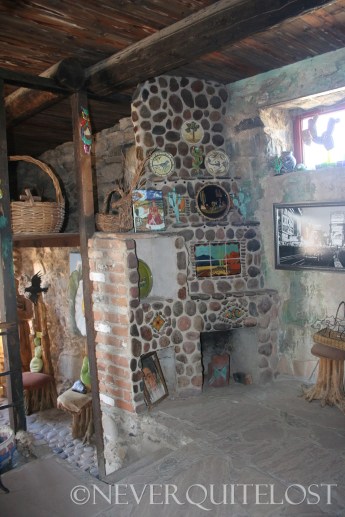 Life magazine covered the opening of the locked compartment, as well as dubbing the place Mystery Castle, although it contained just two $500 bills, some gold nuggets and a Valentine’s card Mary Lou had made for her father when she was a child. Mary Lou stayed on and in fact lived in the house until her death in 2010, although it had no plumbing or electricity until 1992. The accepted story is that this was a labour of love for her on her father’s part, to build her the castle she had always wanted as a little girl. However, I suspect much of this may have been embroidered by Mary Lou to excuse why her father had deserted her; Boyce Gulley seems to have been a selfish albeit talented man who, even after his death, continued to manipulate his family. Mystery Castle is an amazing place, but also a rather sad one; that Mary Lou continued to live in the building seems to be the act of a sad little girl clinging onto an idealised image of her father. I can’t help thinking that, rather than some fantasy building in the desert, she would have much preferred to have her father in her life.






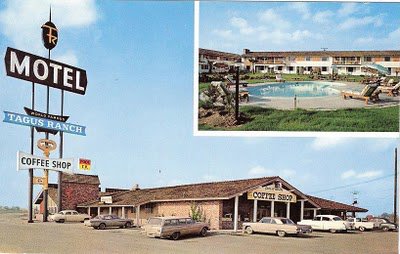

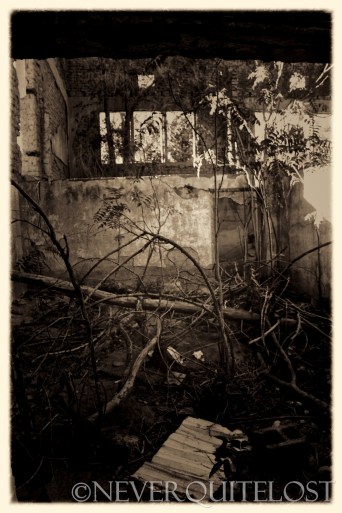 There is a rumour that the blaze was the result of an experiment in a chemistry class, but that’s clearly untrue for two reasons. Firstly, the school was closed due to failing attendances (along with another two local schools in the same year, 1956) not because it burned down, so it clearly didn’t happen while the school was open, and secondly, such a conflagration at a working school would surely have made the local newspapers – which reported just about everything back then. Yet there is nothing in any of those newspapers.


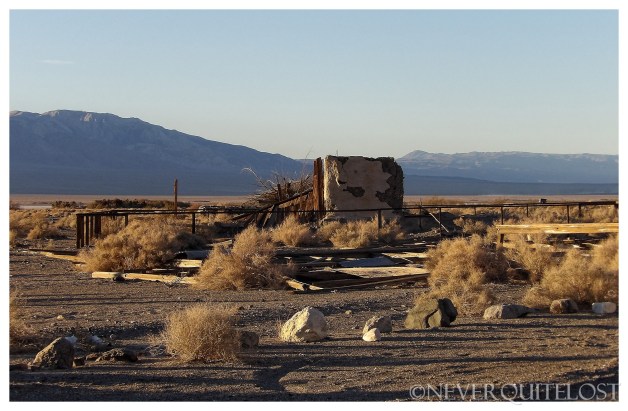
 For its first few years, Ballarat thrived. Some 500 people made their homes in this desolate part of California and the town had seven saloons, a post office, school, jail, morgue, three hotels and a Wells Fargo station. But, apparently, no church.
 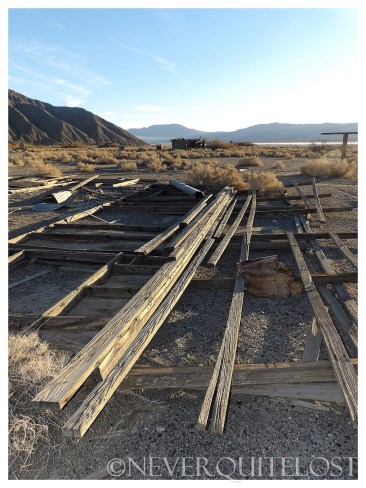 In the 1960s, Charles Manson and his followers moved into the Barker Ranch south of Ballarat, travelling through what was left of the town to get there. In October 1969, he and others were arrested at the Barker Ranch, Ballarat being the last place Manson was a free man. Today Ballarat has a small store run by Rocky Novak with irregular opening hours, the remaining building are mostly in ruins (a plan in the 1960s to make an RV park here failed miserably and finally petered out in the 1990s) and the only reminder of the Manson Family connection is an old Dodge Power Wagon.
  So, where did the Power Wagon now in Ballarat come from? One theory is that it belonged to Bobby Beausoleil and had been left at the ranch. When the arrests and trials were over, Kirk Barker, owner of the Barker Ranch, moved that Dodge down to Ballarat as a runaround. But no-one seems to know for sure.

