There is one man – other than, of course, Cyrus Avery – to whom Route 66 aficionados owe a debt of gratitude. Yet most people know very little about Jack DeVere Rittenhouse, other than the fact that he wrote one of the seminal works on the Mother Road.
In 1946, Rittenhouse published A Guide Book to Highway 66, not only the first book on Route 66, then only two decades old, but the first to chronicle any major highway in the USA. When that book was reprinted in 1988, Rittenhouse wrote the foreword, which is how we know that he undertook the trip in a 1939 American Bantam. For the time, it was tiny – even to modern eyes it looks like the sort of car Noddy or Minnie Mouse might have driven and, in fact, a 1938 American Bantam was the inspiration for Donald Duck’s car. Rittenhouse doesn’t even tell us which model he drove, although it seems likely, as he refers to the lack of trunk, that it was a four-seater Model 60.
Jack Rittenhouse was born in Kalamazoo, Michigan, in 1912 and developed a love of books in childhood. When he was little more than a toddler, his family moved to Arizona, although he returned east as a young man and attended Indiana State Teachers College for three years until the Depression forced him to leave and get a job. Unfortunately his first job, writing book reviews at the Fort Wayne Journal-Gazette didn’t pay, and the young Jack made a few dollars by selling his review copies to libraries. Little is known of his early personal life, although he married Beulah Rose Scherrer on 17th May 1935 in Elkhart, Indiana when she was just 19 years old. There couldn’t have been much of a honeymoon for the very next month, Rittenhouse was riding freight trains to New York City to search for work in publishing.
He was employed by Park Row Books & Magazines in lower Manhattan where he sold used books for six months. But, by 1936, he was off riding freight trains across the country. What Beulah thought of this is not on record, nor what she did while he was off seeing the country, although he was clearly home on occasion because the marriage produced a son, David Kinsey, who was born in Fort Wayne, Indiana, in May 1938.
Returning to New York City, he found work with Alfred A Knopf before moving into advertising because it paid better (he did, however, continue to write a column for the Journal-Gazette, still selling off the books when he’d finished with them). When the Second World War came, he was exempt from joining up and was instead employed writing training manuals for the US Air Force. By now, his marriage to Beulah had ended in divorce and he was living in Chicago, where he met his second wife, Charlotte Jewell High, ten years his junior. They were married in 1944 in Missouri. His job in advertising took them to Los Angeles and along the way Rittenhouse realised that, with the war over, people would want to travel for pleasure and the freedom of the highway, particularly those servicemen and women from the Mid West and the East Coast who had been stationed in California, and they would use Route 66.
So, taking to the road again, this time in his little automobile rather than hopping trains, he began on his travel guide. One presumes Charlotte was a tolerant lady. He researched, wrote, designed and self-published A Guide Book to Highway 66, even drawing the maps and little illustrations, working out mileages and documenting the gas stations, tourist cabins and motels in each place along the road. He printed 3000 copies and sold them for a dollar apiece. In the rather poignant last line of the book, Rittenhouse wrote ‘If you have any suggestions on improving this Guide Book, address them to the publisher, so they can be included in future editions.’ Poignant because there were no future editions and it’s true to say that A Guide Book to Highway 66 was not a runaway success. In fact, the ‘second edition’ wouldn’t come until 1988 and that, of course, would be an accurate facsimile of the original book rather than contain any updates.
For the next few years, Rittenhouse hopped between selling rare books and working in advertising, as well as running his own one-man publisher, the Stagecoach Press. In 1952 he began his own agency, selling it to the Marsteller Company in 1959. The following year, he devoted his time to the Stagecoach Press, producing a number of titles. The publishing house went into hibernation when, after two years at the Museum of New Mexico Press, he joined the staff of the University of New Mexico Press where he worked until he retired in 1978 and promptly started up the Stagecoach once more. However, when the guide was reprinted in 1988, it was with his old employers rather than the Stagecoach Press.
Having fallen in love with New Mexico, he and Charlotte settled in Albuquerque, while Rittenhouse took great pleasure in documenting ghost towns, Indian ruins, mining camps and anywhere that ever had a post office, and many of his photographs are in the Rittenhouse Collection at the New Mexico State University Library.
Charlotte lived to the age of 90,surviving longer than her husband and all three of their children, each of whom died relatively young. Douglas died in 2001 in Texas aged 54; Susan passed the following year at the age of 49, also in Texas, while her sister Anne was just short of 55 when she died in California, having moved there with her husband, Harry Briley, in 1976.
Jack D Rittenhouse died in 1991, having lived long enough to see his little guide become a late success among a whole new generation for whom the Mother Road means nostalgia rather than freedom. Now it’s referred to and quoted by just about anyone who ever writes a word about Route 66, as well as becoming a glovebook essential, just as he intended more than half a century ago.

JACK AND CHARLOTTE RITTENHOUSE WITH THEIR DAUGHTER ANNE AT HER GRADUATION
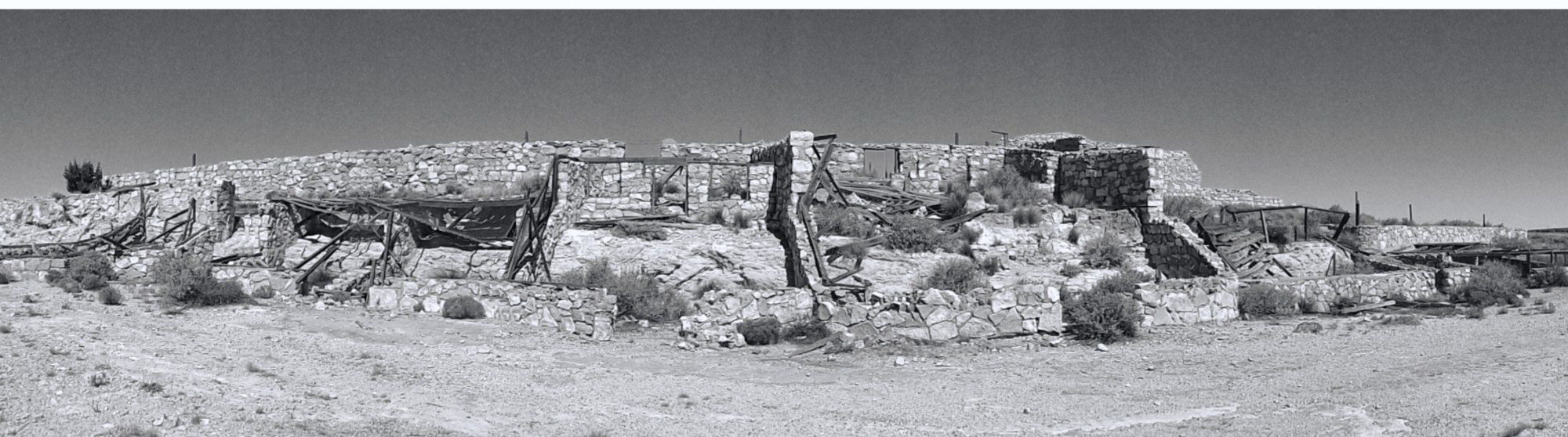

 Although officially known as the Carrara Portland Cement Company Plant, it was usually referred to as the Elizalde works after Angel M Elizalde, a major investor in the plant and director of the company. At the time, it was intended to be one of the most advanced plants of its kind in the USA with houses for the workers. It would produce commercial grey cement and also a fancy high quality cement made from the crushed marble and clay from the nearby Carrara quarry.
 However, the factory never went into operation. The popular notion is that it provided to be too costly and logistically difficult to move the cement. Whether that’s true or not, just a month before production was due to start in July 1941, a fire completely destroyed the machine shop, storehouse, blacksmith shop and an office. A few weeks later, the Carrara Portland Cement Company at Carrara closed down, apparently unable to find parts to replace those lost in the fire.
 The company, however, announced its intention to continue, and then Pearl Harbor happened. The advent of fuel rationing in the following spring made it impossible for the company to run its machinery and transport its goods, even if it had been able to get the plant back up and running, which, without sufficient diesel was impossible. It was abandoned, although some of the machinery remained for several years. Today, the only visitors are those wielding aerosol cans or those who’ve glanced up from Highway 95 and been curious enough to drive the deteriorating track.


 Clyde was two years old himself when his parents, Victor and Lydia, moved to Palmetto from Santa Rosa, California, no doubt hopeful of making that big strike and never dreaming they would lose both their sons so tragically. The marker only mentions Clyde, and people have often assumed that Kenneth was buried with him. However the little boy lies alone, his younger brother having died and been buried in Silver Peak, another town to the north west. The Blair News reported that Mrs Hart had ‘been quite ill for several days prior to starting for California, her illness being aggravated by the mental anguish of the loss of the children in so short a time.’
 After burying their children, the Harts continued back to California; Lydia gave birth to a son, Alan, almost exactly a year to the day after Clyde’s death, and a daughter, Evelyn, in 1910. Both Lydia and Victor lived into old age, Victor dying in 1958 at the age of 80 and Lydia living until she was 97 and they are buried beside each other in the Oddfellows Cemetery in Sacramento. Having lost two children so young, it must have been a consolation that their son and daughter lived long and full lives. Alan died in 1994 and Evelyn just nine years ago aged 96. Did the family ever come back to Palmetto to visit the grave or was it too painful a part of their life?
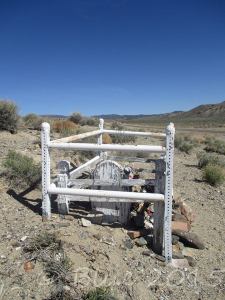 I thought at first how odd it was that there are no other graves in the area, but because Palmetto existed for such a short time – the silver that was struck lasted barely a year – it could be that the little Hart boys were the only people to die out in this lonely place. But the toys and paraphernalia on the grave (I left a toy car) show that they are not forgotten.
 By 1861, it had a population of around 1200, with accompanying saloons, hotels and boarding houses, as well as stabling for those travelling between the Comstock Lode mines of Virginia City and processing mills. Devils Gate,
 Silver City managed to thrive until the completion of the Virginia & Truckee Railroad in 1869 after which the population quickly moved away. Now about 100 or so people live there, most of whom probably knew I was there. It is a little bit The Hills Have Eyes. Apparently, the cemetery is worth a visit, but it appeared to be on the other side of the road closure.